
Halloween is 31 October every year. If you want the useful layer, not the costume-shop version, these seven things cover the date, the name, where the night comes from, and how the pumpkins and sweets started.
7 Things You Need to Know About Halloween

Halloween is 31 October every year. If you want the useful layer, not the costume-shop version, these seven things cover the date, the name, where the night comes from, and how the pumpkins and sweets started.
1. Halloween is always 31 October
Halloween is 31 October every year. In 2026 that falls on a Saturday, which is good news if you like your costume walk unhurried and your Sunday for recovering.
The two church days sit right after it. All Saints' Day is 1 November. All Souls' Day is 2 November. Keep those two dates in mind, because they are the reason Halloween exists at all, and they explain why some countries treat the first days of November as the real event and Halloween as the warm-up.
2. The name is a church word
The name is less spooky than the night. "Hallow" is an old word for a saint or a holy person. All Saints' Day was also called All Hallows, so the evening before it was All Hallows' Eve. Say that quickly and often enough and it wears down to Hallowe'en, then Halloween.
So the word itself is a church word. It points forward to 1 November, not back to the bonfires. The older layer is there too, but you have to look underneath the name to find it.
3. It comes from two layers, not one inventor
Start with Samhain (often said SAH-win or SOW-in). It was a Gaelic festival around 1 November that marked the end of the harvest and the beginning of winter, the darker half of the year. It worked a bit like a new year. People lit bonfires. And there was a strong idea that at this turning point the boundary between the living and the dead grew thin, so the dead could cross over. Some of the customs we still recognize, disguises and fires and food set aside, belong to this world.
Then the church calendar arrived and settled nearby. By the eighth and ninth centuries the Western church was observing All Saints on 1 November, and All Souls later settled on 2 November, a day to pray for the dead. You will often read that Pope Gregory III placed All Saints on 1 November in the eighth century. Treat that as the usual textbook account rather than a sealed fact, and be wary of anyone who tells you a single pope sat down and invented Halloween. Nobody did.
What actually happened is slower and messier. A festival about the dead and the turning year was already there. A set of holy days about saints and the dead landed on top of it. Over centuries the two layers mixed, in different proportions in different places, and the result is the night we have now. That mixing is the honest answer to where Halloween comes from. Not one source. Two, mixed together.
4. Costumes started as disguise
The oldest thread is disguise. If spirits were wandering on this night, one idea was to blend in, to dress so that whatever was abroad would take you for one of its own and leave you alone. Later this became guising, children and young people going out in disguise. The fear faded and the dressing-up stayed, which is roughly how most traditions survive.
5. Trick-or-treat has more than one root
This one does not have a single clean origin, and anyone who gives you one is tidying up. There are at least three roots.
The first is the old practice of leaving food out for spirits, the dead fed so they would pass on peacefully. The second is souling, a medieval custom in England where the poor went door to door on and around All Souls and received soul cakes in return for prayers for the household's dead. The third is guising in Scotland and Ireland, where children performed, a song, a joke, a party piece, and were rewarded for it. You did a small thing, you got a small thing.
The American version, house to house for candy with the phrase "trick or treat," became a widespread neighborhood custom in the mid-twentieth century. It pulled those older threads together and sweetened them. So when a child recites the line at your door, there is medieval prayer and Scottish performance somewhere behind it, however far behind.
6. Jack-o'-lanterns were turnips first
Before pumpkins there were turnips. In Ireland people carved lanterns from turnips and other root vegetables, often with a face, and the folk tale attached to them is the story of Stingy Jack. Jack tricks the Devil more than once. When he dies he is barred from Heaven for his meanness and barred from Hell by the Devil he cheated, so he wanders the dark with a single coal to light his way, carried inside a hollowed turnip. Jack of the lantern.
When the custom crossed to North America, people found pumpkins. They were larger, softer, and far easier to carve than a hard little turnip, so the pumpkin took over and the turnip quietly retired. If you have ever tried to hollow a raw turnip, you understand immediately why.
7. The same dates look different elsewhere
In Ireland, Scotland, the United States, and the UK, the shape is familiar: the night of 31 October, costumes, carved pumpkins, children collecting sweets. Ireland and Scotland are where a lot of it began, which has a kind of circularity I like.
In Mexico, Dia de Muertos falls at the start of November and is connected to Halloween through All Souls. It is its own tradition, with Indigenous roots and its own way of welcoming the dead back for a day. It is not "Mexican Halloween." Flattening it into Halloween misses most of what it is.
In Germany, 31 October is also Reformation Day, which remembers Martin Luther and the year 1517. Halloween itself arrived in Germany much later, as an import. In Catholic regions the older and more established church day is Allerheiligen, All Saints, on 1 November.
In Hungary, Halloween is a recent urban import, pumpkins and costumes turning up in cities over the last couple of decades. The older observance is Halottak napja, the days around 1 and 2 November when families visit the cemetery, clean the graves, and light candles. That is the night that carries weight for most families, quiet rather than costumed.
For another festival where the season does the real work, see how Midsommar 2026 turns the longest days into a whole celebration. Halloween is the other end of the same wheel, the light going instead of staying.
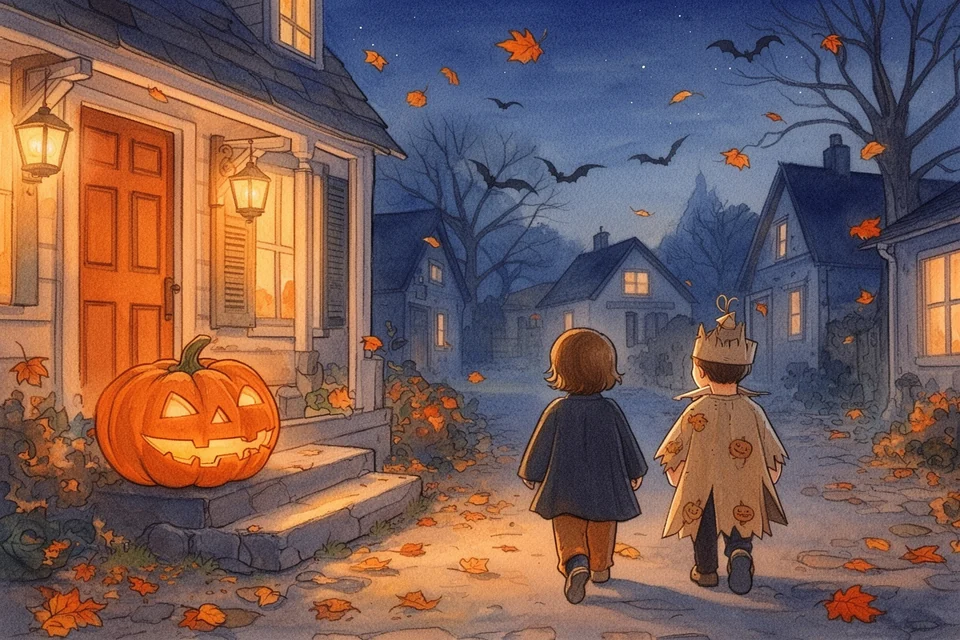
You do not need much to keep the night. A costume, decided in advance or thrown together from the closet. A pumpkin on the step, carved badly and lit anyway, because a slightly wonky face is better than a perfect one you were too tired to attempt. A walk around the block while it is getting dark, which is the real event for most children, the walking more than the sweets.
And if you want one more thing, tell a story at the table. The Stingy Jack tale works. So does a true one, the year someone's costume fell apart halfway down the street, or the house that always gave out the good chocolate. That is usually the part everyone remembers next year.
If you want the night to last past the candy, you can turn the costume walk or the old family tale into a personalized picture book. Start one when you already have the night in mind. No rush. The pumpkin will keep for a few days.
I still think of the walk more than anything else. A street at dusk at the end of October, every door a small decision. That is where Halloween lives: a dark street, a lit face in a window, and a child deciding whether this is the house to knock on.
A little story magic, delivered.
New free stories, thoughtful gift ideas, and occasional Storique news — one lovely email at a time.
- Free stories
- Gift ideas
- Storique news