
Most small children go through a phase that looks like science: a dinosaur obsession, a pocket of "fossils" from the beach, a relentless string of "but why?" questions. Whether the phase fades or grows depends less on schooling than on how the adults around them respond.
How to encourage a child's love of science
Most small children go through a phase that looks like science: a dinosaur obsession, a pocket of "fossils" from the beach, a relentless string of "but why?" questions. Whether the phase fades or grows depends less on schooling than on how the adults around them respond.
Take their questions seriously
A four-year-old asking "why is the sky blue?" is doing what a scientist does: noticing something and refusing to take it for granted. The honest answer is not "because" or "I don't know," it's "let's find out." (Shorter wavelengths of light scatter more in the atmosphere. Most adults don't remember either.)
What matters is the behavior you model: someone who treats a question as interesting and looks for the answer with the child.
Hands-on beats explained
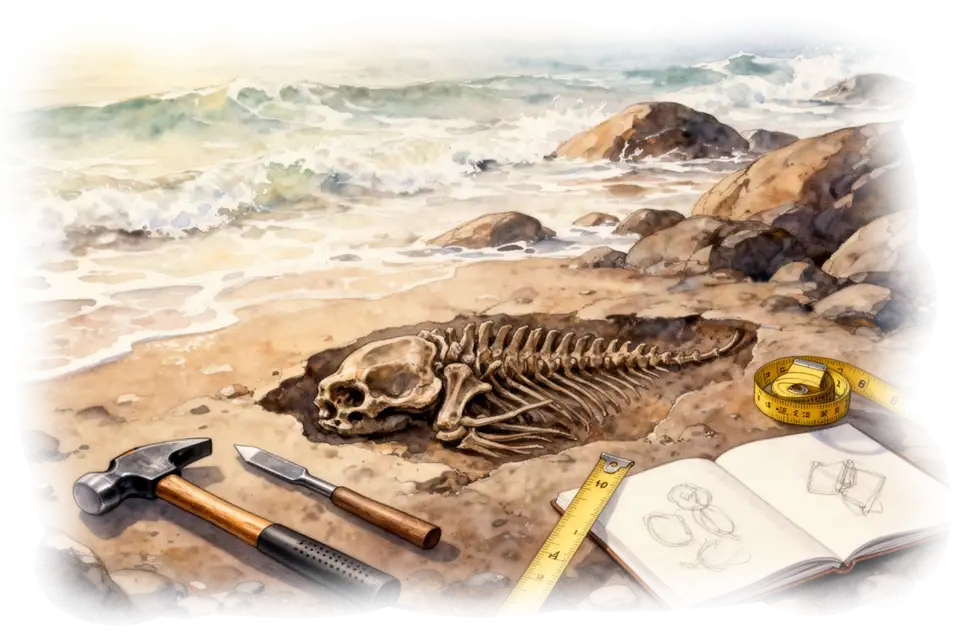
Children remember things they touch. A fossil they found themselves on a coastal walk means more than any museum display they were marched past.
Low-effort starting points:
- A magnifying glass and a garden
- A jar for observing bugs (released at the end of the day)
- Baking soda and vinegar in the sink
- A spoon, a stove, and sugar caramelizing
- A stargazing app held against the night sky
The aim isn't to be educational. It's to give the child the experience of "I noticed this. I wanted to know more. I tried something." That sequence is the actual shape of science.
Take them somewhere real
Museums help, but so do less obvious places: a working observatory, a beach where fossils show in the cliffs, a bird sanctuary, a nature reserve with a ranger who'll answer questions.
Real places, with real specimens and adults whose job this actually is, do something a book can't. They show a child that science is something real people do for a living, not just a subject in school.
Read about real scientists
Most children's science content is about facts (how big a brachiosaurus was, what Saturn's rings are made of). What hooks a child more deeply is meeting the person behind a discovery.
Names that tend to land with younger children:
- Jane Goodall, who lived in the forest with chimpanzees — children can read a free Jane Goodall story online
- Charles Darwin, a young man on a ship, collecting odd birds and tortoises
- Marie Curie, who found two new elements in a leaky shed
- Mary Anning, an English girl who became one of the great fossil hunters of all time
Mary Anning: the perfect first scientist story
Mary Anning was twelve when she helped uncover the first complete skeleton of an ichthyosaur in the cliffs of Lyme Regis, on the south coast of England. She spent her life finding extinct sea creatures in stone (including the first plesiosaur ever identified), at a time when most people still believed the Earth was a few thousand years old and women weren't allowed in scientific societies.
For a child, her story has all of it: a young protagonist, dangerous cliffs, the thrill of finding something nobody has ever seen. Exactly the kind of scientist a kid can imagine being.
Let the child be the explorer
There's one step past reading about scientists: putting the child in the story.
We made Mary Anning’s Fossil Mysteries, a free children’s book series you can read online at Storique for this reason. Each book follows Mary along the cliffs of Lyme Regis with a young companion named Finn, an 8-year-old fascinated by her work. Any child can read all three stories for free. You can also create a personalized version where your own child takes Finn's place, illustrated to look like them, named after them, on their own adventure.
A child who reads about a fossil hunter may go fossil hunting next weekend. A child who reads a fossil adventure starring themselves often doesn't put the book down. They've just been told, in the most concrete way possible, that the role of explorer is theirs.
The takeaway
Foster a child's love of science by keeping them curious, taking their questions seriously, and helping them see themselves as someone who explores the world. Not lessons. Not worksheets. The science follows.
A little story magic, delivered.
New free stories, thoughtful gift ideas, and occasional Storique news — one lovely email at a time.
- Free stories
- Gift ideas
- Storique news