A useful AI storybook prompt names the reader, the main character, one concrete problem or desire, the setting, the tone, and the kind of ending you want. Add two or three details the AI could not know, then ask for a draft you can review rather than a finished book you must accept.
You do not need to write a miniature novel in the prompt box. You need to make a few good decisions before the generator starts making them for you.
How to Write an AI Storybook Prompt (+ Template)

A useful AI storybook prompt names the reader, the main character, one concrete problem or desire, the setting, the tone, and the kind of ending you want. Add two or three details the AI could not know, then ask for a draft you can review rather than a finished book you must accept.
You do not need to write a miniature novel in the prompt box. You need to make a few good decisions before the generator starts making them for you.
Copy this AI storybook prompt template
Fill the blanks that matter and delete the rest.
Write a gentle / funny / adventurous illustrated story for a age-year-old named name, designed for a short bedtime read / independent reading. Aim for reading time or approximate word count across number of illustrated scenes or spreads. Name loves specific interest and often personal habit or phrase. The story takes place setting. Name wants small, clear goal, but problem. Let name make the choice that solves the problem. Include one or two real people, pets, objects, or memories. Avoid anything unwanted. Use concrete language that sounds natural when read aloud. End with the feeling or final image you want, without explaining the moral. Before writing, summarize the plan in four story beats for me to approve.
Filled in, it looks like this:
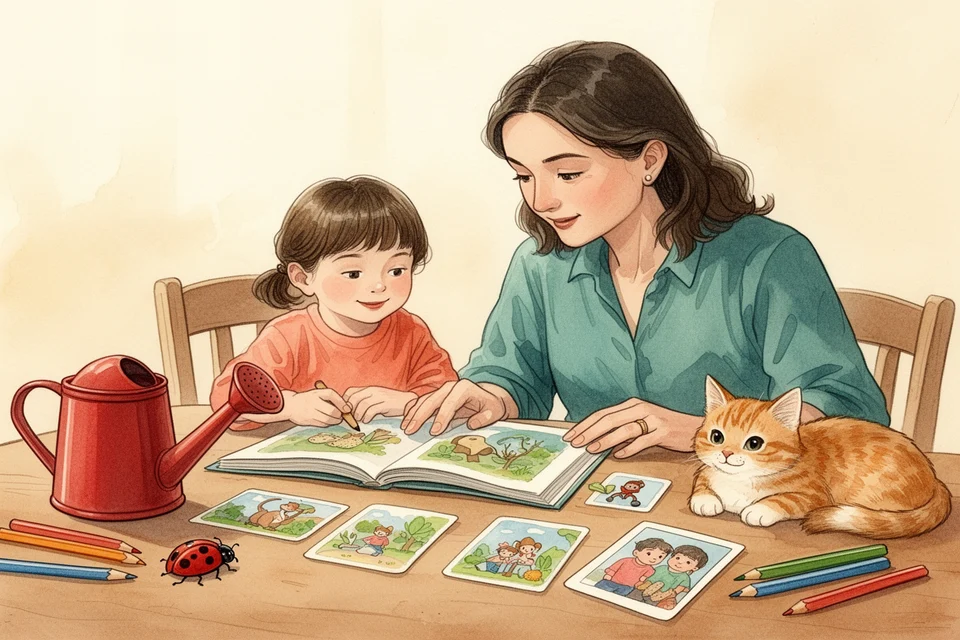
Write a warm, lightly funny illustrated story for a six-year-old named Nia. Make it a five-minute read-aloud with 10 illustrated scenes. She loves beetles and calls her magnifying glass "the detective window." During a rainy afternoon at Grandma's flat, Nia wants to find where the balcony ladybirds hide, but the wind blows her hand-drawn map away. Let Nia notice clues and solve the problem herself. Include Grandma's red watering can and the ginger cat, Feri. Keep the danger small and do not include villains. End with Nia and Grandma drawing a new map at the kitchen table, without stating a lesson. Before writing, summarize the plan in four story beats for me to approve.
The structure works beyond bedtime. For an independent reader, you might ask for four short chapters about a ten-year-old restoring an old bicycle with her uncle, using their workshop nickname and ending with the first ride. Set the length and chapter shape, then keep the character, problem, personal detail, and ending choices.
Start with the child and the reading moment
"Write a children's story" leaves several important questions unanswered. A story read to a preschooler at bedtime needs a different pace from a book an eight-year-old will read alone. Tell the tool who will read it, roughly how old they are, and when the story will be used.
Age is a guide, not a formula. If the child loves long read-alouds, say so. If they are learning the family language and need short, concrete sentences, say that instead. "For a seven-year-old" is less useful than "for a seven-year-old who reads independently but still prefers short chapters." Add a reading time, approximate word count, or number of scenes so the draft fits the book you plan to make.
It also helps to decide how the last page should feel. Calm? Proud? Ready for sleep? The answer will affect the whole story, not only the ending.
Give the story a small, complete shape
Favorite things still need a plot. A dinosaur, a football, a moon base, and a talking rabbit may all belong in the child's world, but something has to happen there.
Reading Rockets describes common story structure through setting, characters, a problem, the attempts to solve it, and a resolution. Turn that into four decisions:
- Where does the character begin?
- What do they want or need to do?
- What gets in the way, and what choice do they make?
- What has changed on the final page?
Keep the problem small enough for one illustrated book. Finding a missing recipe card, helping a nervous dragon cross a bridge, or welcoming a new sibling gives the story somewhere to go. "Save the entire galaxy and learn about kindness" is likely to produce a rushed plot and a speech disguised as an ending.
If you want to develop the plot yourself before prompting a tool, use the fuller guide to writing a children's book story.
Add details the AI cannot guess
Names personalize the surface. Familiar details make the story feel as though it belongs to this family.
Look for a phrase, object, place, or habit with a story attached to it:
- The backpack with one broken zip
- The dog who refuses to walk past the bakery
- Grandad's green mug
- The name a child gives the moon
- The song everyone sings incorrectly in the car
Choose two or three. A prompt packed with a full biography gives every detail too little space. The best test is simple: could the same line appear in a stranger's book? "She is kind and loves adventures" could. "She counts red doors on the walk to school" probably could not.
Real details should influence the action. If you mention Grandad's green mug, perhaps its ring on an old map becomes a clue. Dropping personal facts into the final paragraph like labels will not make the plot personal.
Tell the generator what to avoid
Positive direction comes first, but a short boundary can prevent an obvious mismatch. You might ask for no frightening villains, no teasing about appearance, no separation scene, or no tidy paragraph explaining what the child learned.
Keep the boundary precise. "Make it appropriate" asks the tool to guess your standard. "The child may feel nervous, but nobody is lost, injured, or left alone" is something it can follow.
Tone words help when they point in one direction. "Quiet and curious" is clearer than a pile such as "magical, hilarious, exciting, educational, emotional, and cozy." OpenAI's current prompting guidance makes the same broader point: clear, specific context works better than ambiguity, and revision is part of prompting rather than evidence that the first prompt failed.
Separate the story prompt from the illustration brief
The story prompt decides what happens. The illustration brief decides what the world looks like. They affect each other, but squeezing every visual instruction into the plot request can make both worse.
Start with the reader, character, problem, personal details, tone, and ending. Once the story beats work, make a short visual brief that covers:
- The illustration style and overall color mood
- The recurring character references
- Clothing or objects that must stay consistent
- Details that should never appear as background text
Then review the scenes one by one. A generator may write the right event and still illustrate the wrong action. Google, for example, documents a storybook workflow that can combine a text prompt with uploaded photos or drawings. That convenience does not remove the need to check whether each picture agrees with the words.
For photo-based characters, prepare the references separately. The AI storybook photo checklist covers lighting, angles, expressions, pets, and group photos.
Fix the prompt by diagnosing the draft
Do not rewrite everything because one page is weak. Name the problem first, then make the smallest useful change.
| Draft problem | What to change in the prompt or revision |
|---|---|
| The opening takes too long | Ask to begin with the goal or problem on the first spread |
| The child only watches | State the choice the child must make and remove adult rescue |
| The story feels generic | Replace broad traits with one real object, phrase, or memory |
| Too much happens | Keep one goal and save the second event for another book |
| The language sounds like a lesson | Ask for actions and dialogue; remove the explanatory moral |
| The ending arrives suddenly | Request one quiet closing scene after the problem is solved |
| An illustration contradicts the text | Revise that scene brief instead of changing the whole plot |
Read the draft aloud. Mark the first place your attention slips, the first sentence that sounds unlike your family, and every moment when the picture has to rescue unclear text. Those marks give you a better second prompt than "make it more engaging."
Use personal details with care
A private family book does not need a child's school name, address, daily route, medical history, or other identifying detail. Use the red backpack; leave out the school logo. Use the rainy walk; leave out the street address.
Check the tool's privacy terms before uploading photos or family material. Decide who can view the draft, whether it is public by default, how deletion works, and whether the service explains how uploads are used. UNICEF's online-sharing guidance also recommends involving children in decisions when they can express a view and thinking about the future audience, not only the person posting today.
Ask before including someone else's memory, image, or private joke. A lovely surprise should not require ignoring the person who appears in it.
From prompt to finished storybook
If your idea starts with family photos, the complete guide to making a personalized storybook with photos takes you from the story seed through page review and preservation. Storique can turn that brief and your selected photos into an illustrated draft you can review. Follow the step-by-step storybook guide when you are ready to build it.
Frequently asked questions
How long should an AI storybook prompt be?
Long enough to settle the reader, character, setting, problem, personal details, tone, boundaries, and ending. That may be one compact paragraph. More words do not automatically produce a better story; clear decisions do.
Should I ask the AI to write the whole book at once?
Ask for a short outline or four story beats first. Approve the shape, then generate the draft. This catches a passive hero, an oversized plot, or the wrong ending before those problems spread across every page.
What makes a personalized story prompt feel personal?
Use details that affect the plot: a real phrase, familiar object, recurring habit, meaningful place, or shared memory. A name and a list of positive traits are rarely enough.
Can I use the same prompt in another language?
Use the same story decisions, but rewrite the prompt naturally for that language and reading context. Keep names and family details, then adjust expressions, rhythm, and cultural references instead of translating every sentence literally.
Sources
- Prompt engineering best practices for ChatGPT, OpenAI Help Center
- Create personal illustrated storybooks in the Gemini app, Google
- Reading for Meaning: Recognizing story structure, Reading Rockets
- What you need to know about sharenting, UNICEF Parenting
A little story magic, delivered.
New free stories, thoughtful gift ideas, and occasional Storique news — one lovely email at a time.
- Free stories
- Gift ideas
- Storique news