
World Teachers' Day 2026 is Monday, October 5. UNESCO says this year's observance will focus on protecting and advancing the status of the teaching profession. It also marks 60 years since the ILO/UNESCO Recommendation concerning the Status of Teachers was adopted on October 5, 1966.
The policy language can feel far removed from a child's thank-you note, but both begin with noticing the work. A good family activity can start with one specific memory instead of another object printed with "Best Teacher."
World Teachers' Day 2026: 12 Meaningful Thank-You Ideas

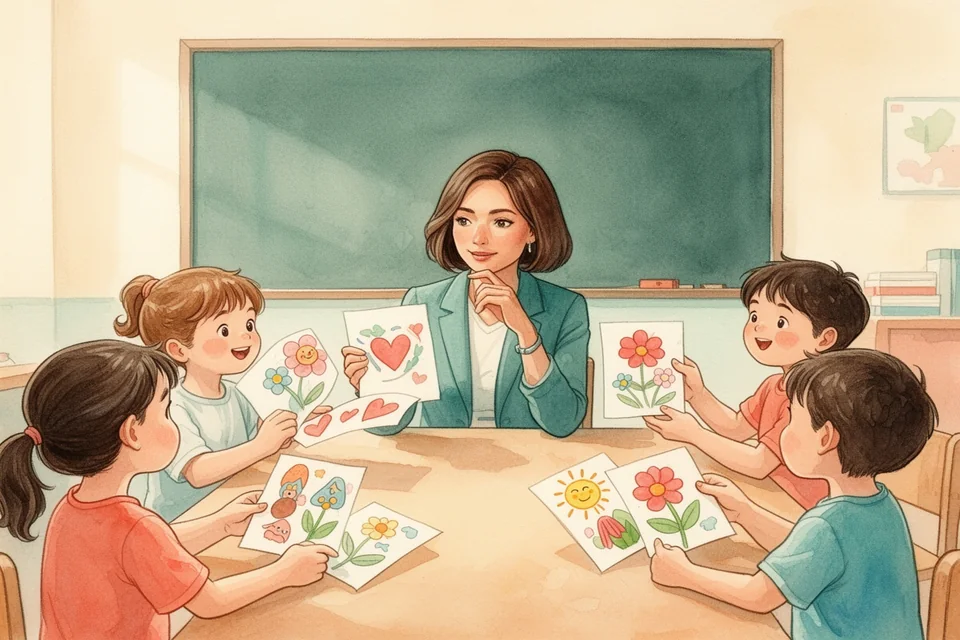
World Teachers' Day 2026 is Monday, October 5. UNESCO says this year's observance will focus on protecting and advancing the status of the teaching profession. It also marks 60 years since the ILO/UNESCO Recommendation concerning the Status of Teachers was adopted on October 5, 1966.
The policy language can feel far removed from a child's thank-you note, but both begin with noticing the work. A good family activity can start with one specific memory instead of another object printed with "Best Teacher."
| Quick fact | Answer |
|---|---|
| Date | Monday, October 5, 2026 |
| First celebrated | 1994 |
| What is special about 2026? | The 60th anniversary of the 1966 ILO/UNESCO Recommendation |
| Official 2026 focus | Protecting and advancing the status of the teaching profession |
| Convened by | UNESCO, ILO, UNICEF, and Education International |
Is there an official World Teachers' Day 2026 theme?
UNESCO's official 2026 page does not publish a short theme in quotation marks. It describes a focus: protecting and advancing the status of the teaching profession in a rapidly changing world.
Several unofficial calendars turn that summary into a slogan, and their versions do not always agree. If UNESCO later adds a formal theme, its World Teachers' Day page is the source to check.
The 2026 observance also looks back to the ILO/UNESCO Recommendation adopted 60 years earlier. It covers teachers' rights and responsibilities, preparation, recruitment, employment, and working conditions. UNESCO is revising it to address changes such as artificial intelligence, inclusion, climate disruption, and education during emergencies.
Before choosing a thank-you
World Teachers' Day is not mainly a shopping occasion. A teacher may appreciate a gift, but a precise sentence from a child often says more than a generic mug or plaque.
Keep the plan easy to receive. Check the school's gift rules, especially before collecting money. Do not give a teacher a project to finish, a plant to keep alive, or a large object to store. If an activity uses a child's name, voice, photograph, or work, ask the child and their parent or guardian before sharing it beyond the family.
Choose one idea below. Completing all 12 would rather miss the point.
12 meaningful ways to thank a teacher
1. Finish one specific sentence
Start with: "Thank you for helping me..." Ask the child to finish it in their own words. UNICEF has used a similar prompt in its thank-you-teacher campaign because it gives children a simple place to begin.
Specific answers are the ones a teacher remembers: "Thank you for helping me read the long chapter book," or "Thank you for waiting when I forgot what I wanted to say." Keep the child's phrasing, even if an adult could make it neater.
2. Write down one ordinary classroom memory
Ask, "What is one small thing about this class that you think you will remember?" The answer might be the teacher's weather chart, a joke during maths, the quiet corner, or the day a caterpillar escaped its container.
Ordinary details make a note feel real. They also show the teacher which parts of classroom life reached a child, including moments that may have seemed unremarkable at the time.
3. Add a caption to a drawing
Let a younger child draw a classroom moment, then ask what is happening in the picture. Write their explanation underneath without correcting it into adult language.
A caption such as "This is when we planted the beans and mine came up last" carries a whole story. The drawing does not need to be polished, and the teacher does not have to guess what it represents.
4. Make a tiny before-and-now card
Fold a sheet of paper in half. On the left, complete "At the start of the year, I couldn't..." On the right, complete "Now I can..."
The change can be academic, practical, or social: reading a bus timetable, joining a game, asking for help, tying an apron, or speaking in front of the class. This gives the teacher a clear view of progress from the child's perspective.
5. Name a moment when the teacher noticed
Ask the child when the teacher made them feel seen. Perhaps the teacher remembered a favorite animal, noticed they were worried, gave them a harder problem, or asked about a missing pet.
Turn the answer into two or three sentences. Avoid broad praise such as "You are the best teacher ever." One remembered action is more believable and more personal.
6. Send a family note with two voices
Give the child most of the page, then add a short paragraph from the adult. The child can describe what happened at school. The adult can describe the change noticed at home.
For example: "Mira talks about books at breakfast now. Thank you for giving her stories she wanted to carry home." The two viewpoints show the same work from different sides without becoming a formal evaluation.
7. Collect one line from each child
For a small group, ask every family for one sentence beginning with the same prompt. Put the sentences on a single sheet or in a thin booklet. Set a firm word limit so one parent is not left editing a pile of essays the night before.
Use first names only if every family agrees. A class contribution should remain optional; no child needs to explain why they did not take part.
8. Record a short private audio thank-you
Some children speak more naturally than they write. Record a message of 20 or 30 seconds in a quiet room. A child can say what they learned, recall one funny moment, or read their note aloud.
Send it privately rather than posting it. If several families contribute, one adult should combine the clips and confirm permission for every recording. Keep the finished file short enough for the teacher to hear in one sitting.
9. Build a four-page class memory booklet
Use four simple sections: "Something we learned," "Something that made us laugh," "A challenge we got through," and "What we will remember." Children can add a sentence or drawing to one section rather than every page.
A short structure is easier to finish and easier to read than a large scrapbook. Give the teacher a completed copy, not loose pages that still need sorting.
10. Ask what would actually help
If the family or class wants to spend money, ask the teacher or school what is useful and permitted. The answer may be a particular classroom book, art material, or contribution to an existing fund. It may also be "nothing, thank you."
Listening to that answer fits the 2026 focus better than guessing. Appreciation should not create storage, paperwork, or an awkward policy problem.
11. Tell the school what the teacher did well
Send a concise note to the head teacher or school leader and copy the teacher. Name the practice you valued and what it changed for the child.
This is different from a private thank-you. It puts useful recognition where professional decisions are made. Keep it factual: describe the patient reading support, thoughtful communication, welcoming classroom routine, or another action you personally observed.
12. Turn one true memory into a story
Choose a small classroom event with a beginning, a problem, and a change. Perhaps a child was afraid to read aloud, the class tried an experiment that failed, or a lost costume was found just before a play. Ask the child which details must stay true and which parts can become imaginative.
The story can remain handwritten. If the teacher and family want an illustrated keepsake, Storique can turn a story idea and approved photos into a personalized book with up to three real characters. Use photographs only with permission, and avoid including a whole class of identifiable children. The guides to writing a children's book story, choosing photos for an AI storybook, and how an AI storybook is made explain the process before you decide whether to start a book.
Match the idea to the child's age
| Age or stage | A manageable contribution |
|---|---|
| Preschool | A drawing and one dictated sentence |
| Early primary | One specific thank-you and a short memory |
| Older primary | A before-and-now card or a page for a group booklet |
| Teenager | A direct letter, audio message, or note to the school leader |
Treat these as starting points. A teenager may prefer to draw, and a younger child may have a long story to dictate. The best format is the one that lets the child's own observation survive.
A simple plan for October 5
Ask one question a few days beforehand: "What did your teacher do this year that you want them to know mattered?" Write down the first concrete answer. Let the child choose a note, drawing, recording, or short story, then finish it before adding anything elaborate.
Deliver it privately on Monday, October 5, or on the nearest school day that suits the class. There is no need to wait for an assembly or coordinate a large group. A quiet thank-you still counts.
Frequently asked questions
When is World Teachers' Day 2026?
World Teachers' Day 2026 is Monday, October 5. The global observance takes place on October 5 every year.
What is the World Teachers' Day 2026 theme?
UNESCO has not published a short official slogan for 2026. Its official page says the observance will focus on protecting and advancing the status of the teaching profession in a rapidly changing world. The year also marks the 60th anniversary of the 1966 ILO/UNESCO Recommendation concerning the Status of Teachers.
Why is World Teachers' Day on October 5?
The date marks the adoption of the ILO/UNESCO Recommendation concerning the Status of Teachers on October 5, 1966. World Teachers' Day has been celebrated since 1994.
Is World Teachers' Day the same as a national teacher appreciation day?
Not always. October 5 is the UNESCO-led global observance. Countries and school systems may hold national teacher days or appreciation weeks on other dates, so check the local calendar if you are planning a school activity.
What should I write in a teacher thank-you note?
Name one thing the teacher did, then explain what changed. "Thank you for letting me try the science demonstration again. I stopped being scared of getting it wrong" says more than a general compliment.
Sources
A little story magic, delivered.
New free stories, thoughtful gift ideas, and occasional Storique news — one lovely email at a time.
- Free stories
- Gift ideas
- Storique news