
Do not begin by sorting every photo on your phone. That is how this job turns into a second job. Start with the shape of the book, then look for the few pictures and notes that can fill it.
How to Make a Baby Memory Book From Photos

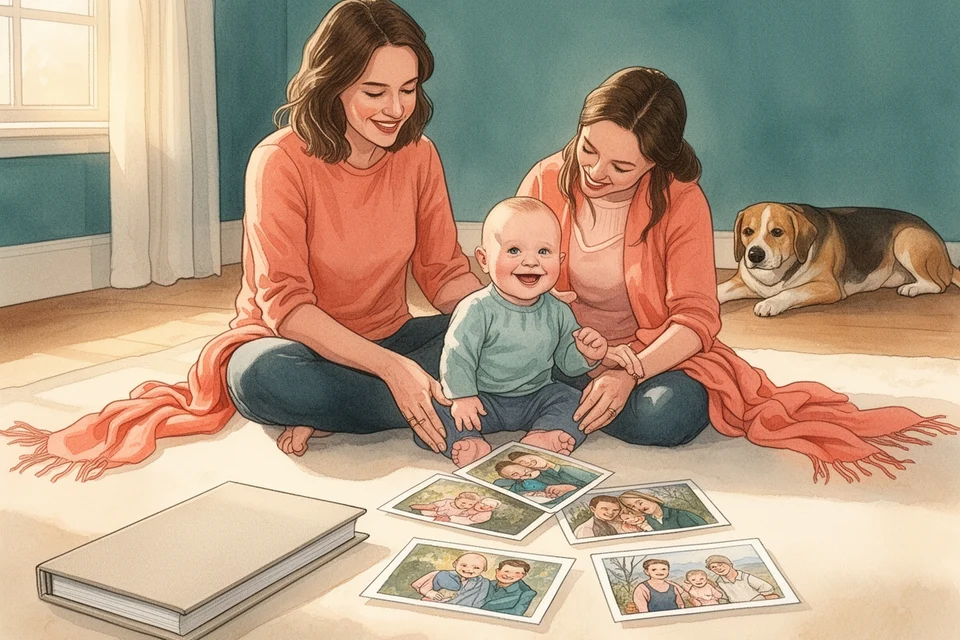
Do not begin by sorting every photo on your phone. That is how this job turns into a second job. Start with the shape of the book, then look for the few pictures and notes that can fill it.
Choose the kind of baby book first
"Baby memory book" can describe three different things. Pick the format that matches what you want to keep.
| If you want to preserve... | Make... | Include... |
|---|---|---|
| The baby's appearance across the year | A photo book | Chronological photos, short captions, dates, and names |
| Birth details and milestones | A journal or fill-in album | Firsts, measurements, family notes, and original documents |
| One readable version of the first year | A storybook | A small cast, selected moments, a narrative thread, and an ending |
A storybook is not the complete archive. Keep physical mementos, the photo library, and the exact milestone list separately.
PBS KIDS suggests choosing important events, adding pictures and captions, then looking through the finished pages together. Its memory-book activity is aimed at older children, but the method also works when adults assemble a baby's first year.
Gather memories in one short pass
Create a note with four columns: date, photo, fact, and voice. Give yourself 30 minutes.
- Date: an exact date or a safe label such as "early spring."
- Photo: the file name or album location.
- Fact: something verifiable, such as who visited.
- Voice: a phrase, sound, or odd detail people still repeat.
Look in your favorites album, family messages, calendar, and notes app. Ask a relative for three moments they remember. Their answers may beat another hundred near-identical photos.
Do not turn uncertainty into fact. "We think this was the first time you met Aunt Lea" is an honest caption.
The U.S. National Archives recommends adding basic "who, what, where, and when" metadata to digitized family material. Its family digitization guide also advises keeping originals and backing up files.
Cut the photo pile down to 8 to 12 moments
The best picture is not always the most polished one. Choose images that give you something to say.
Keep a mix of:
- a scene that shows the beginning;
- ordinary routines alongside formal milestones;
- people or animals who belonged to daily life;
- a final scene that shows what changed.
Two breakfast photos can tell more than six portraits. The cup the baby reached for or the dog beneath the high chair can become an action in the story.
If a photo contains another child, ask their parent or guardian before uploading it. You can usually keep the memory without using their face.
Find one story inside the first year
A year is a time span, not a plot. Give the book one idea that can carry the selected moments.
For example:
- The baby travels through four seasons and gathers a family ritual from each one.
- A favorite toy keeps turning up at breakfast, on walks, and at the first birthday.
- A grandparent narrates the visits, calls, and tiny changes they witnessed from near or far.
Avoid a month-by-month parade. "In month seven you sat up" records a fact. "You sat up because the cat stole your yellow sock" gives the page a reason to exist.
Write the whole book in one sentence before you outline it:
During her first year, Mina follows the red scarf through winter walks, spring floor games, a windy summer picnic, and her first birthday, until she finally carries it to the door herself.
Build a six-scene page plan
Six scenes are enough to test the idea.
- Opening: Show the baby in a familiar place with one recurring object or person.
- Invitation: Give the child something to notice, reach, follow, or join.
- Two early attempts: Use real first-year moments that move the same idea forward.
- Change: Let the child do something they could not do at the beginning.
- Return: Bring back the opening object, phrase, or place in a new way.
- Ending: Close with the family at the first birthday or another verified moment.
The child does not need a villain. Recognizing Grandma on a video call or carrying the red scarf can be enough.
Separate reference photos from memory photos
Memory photos show what happened. Reference photos show what a recurring character should look like. They are not always the same set.
For a recognizable baby character, choose clear images where the face is visible and the baby appears alone. Use photos from roughly the age the illustrated character should represent.
Storique asks for 4 to 8 high-quality photos for each real person, with only that person visible. A book can include up to three real characters. The photo-selection guide covers lighting, angles, and cropping.
Other photos can stay beside the draft as factual references. You do not need to upload every bath, medical, or location image simply because it exists.
Write a brief that protects the real memories
Give the story maker verified facts, the recurring thread, and permission boundaries.
Create a warm picture-book story about Mina's first year, told by her mother. Mina appears at about eleven months old throughout the illustrations. A soft red scarf is the recurring object. Use these verified scenes: a winter pram walk, reaching for the scarf during spring floor play, a windy picnic with the family dog, and carrying the scarf to the door on her first birthday. End with the scarf tied to her birthday chair. You may invent small actions between these moments, but do not invent developmental milestones, medical details, exact dates, or dialogue attributed to relatives. Keep the sentences short enough to read aloud.
The AI storybook prompt template gives you separate fields for character, setting, plot, tone, exclusions, and illustration notes.
Make the illustrated version in Storique
Use Storique when you want an illustrated story rather than a grid of photos. The baby can appear with a parent, grandparent, sibling, or family animal. Storique creates the first version, then lets you edit the text and individual illustrations.
First-year memories are specific. A generated page may change the scarf color, add a tooth, or place a relative in a scene they missed. You control the final version, so correct the text and artwork before sharing or printing.
The digital purchase includes web and iPhone/iPad reading plus PDF and ePUB downloads. You can order a hardcover separately. The Storique guide explains the flow; pricing lists current costs.
Review the book in three passes
- Facts: Check names, relationships, sequence, locations, and quoted phrases against your notes.
- Pictures: Compare the baby's face, age, clothing, recurring objects, hands, and family members across pages.
- Read-aloud rhythm: Read the whole book slowly. Cut explanations that the illustration already gives and split sentences that need two breaths.
The American Academy of Pediatrics recommends reading with children from birth. Its guide to sharing books with babies notes that babies respond to voice, pictures, and repetition. You do not need to finish the book every time.
Ask another adult who lived through the year to read the draft. They may spot a swapped season or invented detail.
Keep private details out of the plot
A baby book can feel personal without containing a full birth date, medical record, home address, daycare name, or daily schedule. Use only the details the story needs.
The UK Information Commissioner's Office defines data minimisation as collecting and retaining only what a specific purpose requires. Apply the same test to the book: does this detail improve the story, or is it merely available?
Tell relatives how their photos or words will be used. Keep working files private, and think before posting finished pages publicly. A family keepsake does not need to become a social post.
Starting late is not a failure
You can make a first-year book years later. Start with what survived, label uncertainty, and leave gaps rather than inventing details.
The family-photo digitization guide covers file names and backups. If a birthday is approaching, the first birthday gift guide can help place the storybook within a larger keepsake.
Finish a small, truthful book instead of planning a perfect archive forever.
Frequently asked questions
What should I put in a baby memory book?
Include ordinary routines, important people, captions, and verifiable details. Keep official documents and the full photo archive separately.
How many photos do I need for a baby storybook?
Plan with 8 to 12 memory photos. For a real Storique character, choose 4 to 8 clear reference photos where that person appears alone. The sets do not have to match.
Can I make a baby memory book after the first birthday?
Yes. Use photo dates, messages, calendars, and relatives' memories to rebuild the outline. Mark approximate dates honestly; leave blank months blank.
Should the book show every month of the baby's first year?
Only if each month adds something. Six strong scenes may be enough. Choose a photo album when complete monthly coverage matters more.
Is a baby photo book the same as a baby storybook?
No. A photo book arranges real photographs. A storybook turns selected memories into a narrative and may use illustrations based on reference photos. Storique supports the second format with editable text and illustrations plus optional hardcover printing.
Sources
- Make a memory book, PBS KIDS for Parents
- How to share books with your baby, American Academy of Pediatrics
- Digitizing family papers and photographs, U.S. National Archives
- Children's code: data minimisation, UK Information Commissioner's Office
A little story magic, delivered.
New free stories, thoughtful gift ideas, and occasional Storique news — one lovely email at a time.
- Free stories
- Gift ideas
- Storique news