
A long-distance family storybook should give two households the same small world to enter: a familiar person, one true detail, and a plot worth reading again. Start with one shared ritual or memory, not a complete family history.
The useful material may already be hiding in ordinary calls: Grandpa's terrible knock-knock joke, the red mug Aunt Nora always uses, or the route from the train station to Grandma's flat.
How to Make a Long-Distance Family Storybook

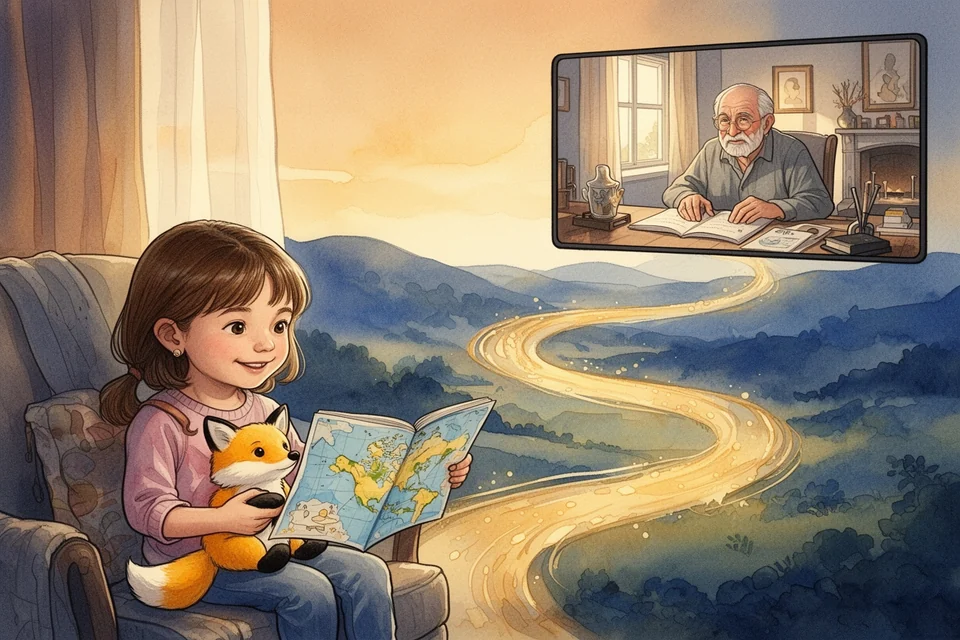
A long-distance family storybook should give two households the same small world to enter: a familiar person, one true detail, and a plot worth reading again. Start with one shared ritual or memory, not a complete family history.
The useful material may already be hiding in ordinary calls: Grandpa's terrible knock-knock joke, the red mug Aunt Nora always uses, or the route from the train station to Grandma's flat.
Choose what the book needs to do
"Long-distance family book" can describe several projects. Decide which one you are making before asking everyone for photos.
| If the family wants to... | Make... | Keep at the center... |
|---|---|---|
| Remember the last visit | A memory story | One day, one problem, and details that really happened |
| Feel part of each other's routine | A parallel-day story | Familiar objects, repeated phrases, and both homes |
| Look forward to the next visit | A future adventure | A possible plan clearly treated as fiction, not a promise |
| Preserve a relative's childhood memory | A family-history story | The speaker's account, with invented scenes marked as invented |
A storybook is not a substitute for calls, visits, recordings, or a photo archive. Its job is narrower: turn one piece of the relationship into something a child and a distant relative can pick up and share.
Give the distant relative something to do
Do not make Grandma a face in the final parade or Dad a voice that only appears in a letter. If the book is meant to support a relationship, the distant person needs choices, mistakes, jokes, and useful actions.
A 2022 observational study followed 48 families during video chats between infants and grandparents. Grandparent sensitivity predicted positive infant affect in both video and in-person interactions. The study did not test storybooks, and its sample was mostly highly educated and White/Caucasian. Use the book as a prompt for conversation rather than evidence that a book by itself creates closeness. Read the study abstract in Infancy via PubMed.
Write the book so it can prompt that back-and-forth. Leave room for the relative to ask, "Do you remember what happened next?" Add a repeated line both people can say.
Collect one story on a short call
Ask for a specific scene, not a life summary. A short call will usually give you better material than a group chat full of adjectives.
Try questions like these:
- What did we do the last time we laughed together?
- Which object in your home would the child recognize?
- What snack, game, or phrase belongs to your visits?
- What went slightly wrong on a trip or family day?
- Which detail should never be changed in the story?
Ask before recording. The Library of Congress family oral-history guide recommends getting permission and asking relatives about their lives.
Save the original answer separately. A polished story can simplify time, combine minor moments, or invent a talking animal. It should not quietly replace the relative's account.
Build the plot around a bridge
Distance is the setting, not the whole plot. "We miss each other" may be true, but it gives the characters nothing to do for twenty pages.
Choose a bridge that can carry the action between homes:
- a recipe whose missing instruction must be recovered;
- a small parcel with clues from another city;
- a map made from memories of the last visit;
- a shared object, such as two matching toy animals, that appears in both places.
Then give the main characters one modest problem. The recipe card is smudged. The parcel's final clue makes no sense. The child remembers the park but not which gate leads to the pond. The problem should let both the near and far family members contribute.
Avoid plots that promise a reunion date the adults cannot guarantee. For a parent who travels, a relative in the military, or a family managing separation or custody, agree on the language with the child's caregiver. A gentle fictional adventure may be a better fit than explaining an adult situation the book cannot resolve.
Choose photos for characters, not as a timeline
Photos from the last visit help you remember the blue suitcase or the bakery near the station. Character photos show what each person looks like now.
For each real Storique character, choose 4 to 8 clear photos of that person alone. Include a front view and a few useful angles in steady light. The photo-selection checklist covers cropping, glasses, hair, expressions, and common rejection problems.
Keep a separate list of who is in each scene, where and when it happened, which details are exact, and what the story may invent or must leave out.
The U.S. National Archives recommends adding "who, what, where, and when" metadata to family scans, keeping the originals, and backing up digital files in its family digitization guide.
Write a brief that works from both homes
Tell the story maker what each person contributes and which details should recur.
Write a warm adventure for five-year-old Mina and her grandfather Bálint, who live in different countries. Mina carries a knitted yellow fox. Bálint wears round glasses and drinks tea from a red enamel mug. During their Sunday video call, Bálint shows Mina an old map from his hometown. One corner is missing. They follow clues in both homes and discover that the missing corner became a bookmark in Bálint's recipe notebook. End with them cooking the same biscuits in their separate kitchens. Use the repeated line, "Same plan, different kitchen." Do not add a reunion date, home address, school name, medical detail, or dialogue from other relatives.
That brief gives the characters a shared task and ends with something the family can repeat. Change any invented biographical detail before generation. The AI storybook prompt template has fields for characters, setting, plot, tone, exclusions, and illustration notes.
Build and edit the book in Storique
Storique is a strong fit when you want an original plot and recognizable illustrated family members instead of a fixed story with names inserted into it.
You can include up to three real people, animals, or fictional characters. After Storique creates the first version, you can edit the text and individual pictures, add or reorder pages, and inspect the complete digital book before deciding whether to order a hardcover. The finished book can also be read on the web or iPhone/iPad and downloaded as PDF or ePUB.
One household may catch a wrong front-door color; the other may notice that Grandad never wears a tie. Treat the first version as a draft that both sides can check.
The Storique creation guide explains the workflow. Pricing lists the current digital-book and optional hardcover costs.
Review facts and feelings separately
First, check names, ages, hair, glasses, recurring objects, places, and family roles. Look at every illustration at full size and regenerate a picture if a likeness or repeated object is wrong.
Then read for emotional accuracy. Does the child solve a problem, or merely wait to be reassured? Does the story acknowledge two homes without making one feel temporary or lesser?
Ask one adult in each household to mark incorrect facts and uncomfortable implications, not rewrite every sentence. For a surprise, ask someone who knows the recipient's routines and boundaries.
Share the story without oversharing
The plot rarely needs surnames, exact addresses, school names, travel dates, custody arrangements, or a child's daily schedule. First names and a broad setting are usually enough.
The UK Information Commissioner's Office defines data minimisation as collecting only the personal information needed for a specific part of a service. Apply the same test to every fact and photo: does it improve this book, or is it merely available?
Ask an adult relative before using their image or recorded words. Ask a parent or guardian before using another child's photos. Keep the full interview and original pictures in the family archive rather than uploading everything to the story project.
Turn the finished book into a small ritual
Pick one simple way to use the book across both homes.
Read the same spread during a regular call. Pause at the repeated line so both people can say it together. Let the distant adult tell the true memory behind one picture, then let the child invent what happens after the final page.
This is where Storique's editable story earns its place. The book can carry real family details and still work as a complete adventure. It gives the relationship a shared object, but the people on both sides supply the attention.
For more gift ideas built around the same problem, see thoughtful gifts for long-distance families. If the project grows into several interviews and a family archive, use the family-story preservation guide before selecting one memory for the book.
Frequently asked questions
What should a long-distance family storybook be about?
Choose one shared ritual, true memory, or plausible future adventure. Give the child and distant relative a modest problem they can solve together. Avoid trying to summarize the whole relationship.
Can a grandparent and grandchild both appear in a Storique book?
Yes. Storique supports up to three real people, animals, or fictional characters in one book. Give each real person 4 to 8 clear reference photos and a distinct role in the plot.
How do I make the story feel personal without adding private information?
Use recognizable but low-risk details: a mug, a pet, a family phrase, a favorite snack, or a broad setting. Leave out full names, addresses, school names, schedules, travel dates, and sensitive family circumstances.
Should the story be true or fictional?
Either can work. Keep a true memory accurate, and label invented transitions or scenes as part of the story. For a fictional adventure, use real character details without presenting invented dialogue or promises as fact.
What if the two households disagree about the draft?
Resolve factual and emotional concerns first. A wrong relationship, unwanted promise, or private detail matters more than a preferred adjective. Use Storique's editor to change the text or individual illustrations before ordering a hardcover.
Sources

A little story magic, delivered.
New free stories, thoughtful gift ideas, and occasional Storique news — one lovely email at a time.
- Free stories
- Gift ideas
- Storique news