
To preserve a family story, record it in the person's own words, identify the people, places, and dates while someone can still confirm them, then keep the original recording with a transcript and labeled copies of the related photos or documents. Aim for three copies on two kinds of storage, with one off-site. A printed book can make selected stories easier to share, but it should not replace the original files and evidence.
You do not need to document a whole life this weekend. One well-recorded story about a kitchen, a journey, a first job, or the day two people met is a real beginning.
Once the source files are safe, Storique can turn one selected memory and family photos into a personalized illustrated book. You keep the archive; your family gets a story to read together and a hardcover to pass on.
How to Preserve Family Stories: A Practical Guide

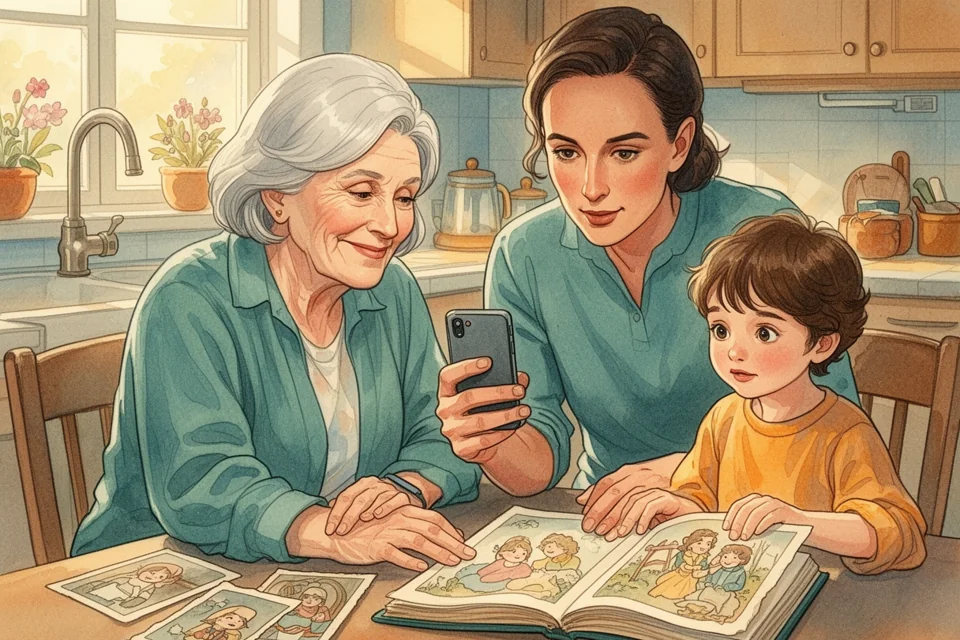
To preserve a family story, record it in the person's own words, identify the people, places, and dates while someone can still confirm them, then keep the original recording with a transcript and labeled copies of the related photos or documents. Aim for three copies on two kinds of storage, with one off-site. A printed book can make selected stories easier to share, but it should not replace the original files and evidence.
You do not need to document a whole life this weekend. One well-recorded story about a kitchen, a journey, a first job, or the day two people met is a real beginning.
Once the source files are safe, Storique can turn one selected memory and family photos into a personalized illustrated book. You keep the archive; your family gets a story to read together and a hardcover to pass on.
Decide what you are trying to save
"Family history" can mean several different things. Separating them prevents one book or folder from carrying a job it cannot do.
| What you want to preserve | Best starting format | What it keeps |
|---|---|---|
| A person's voice and exact account | Audio or video recording | Their words, tone, pauses, and way of telling the story |
| Names, dates, and relationships | Notes, captions, and a simple index | The context that makes recordings and photographs understandable |
| Original letters, recipes, and photographs | Safe physical storage plus careful digital copies | The source material itself |
| A life story for relatives to read | Transcript, memoir, or family history book | A selected and edited account |
| One memory for children or a gift | Personalized Storique storybook | An illustrated, editable retelling built around your family |
An oral-history recording is a source. A storybook is an adaptation. Both can matter, but they are not interchangeable. If you turn Grandad's account of getting lost on his first day of work into an illustrated adventure, keep the recording in which he actually told it.
1. Start with one person and one subject
"Tell me your life story" is a large request. Choose a smaller door:
- The house where you grew up
- The first work you were paid to do
- A family recipe and the person who taught it
- Moving to a different town or country
- How two people met
A clear subject gives the conversation somewhere to begin without deciding in advance where it must end. If you need questions, the 50 questions for recording a grandparent's stories cover childhood, work, relationships, places, and change.
If your starting point is a treasured dish, the family recipe storybook guide shows how to preserve a tested recipe and turn the memory around it into a separate illustrated story.
Ask permission before recording. Explain who will keep the file, who may hear it, and whether you hope to quote or publish any part. Permission for a private family recording is not automatic permission to post clips publicly or give the file to a service.
Some memories involve people who did not agree to be recorded. You can keep a passage private, restrict who receives it, or leave it out of a public-facing book.
2. Record a conversation, not an interrogation
StoryCorps recommends planning questions in advance, starting with warm-up questions, and asking things that cannot be answered with yes or no. It also advises treating the list as a guide rather than a script. The useful follow-up is often prompted by what you just heard.
Set a phone or recorder between you in a quiet room. Make a short test and play it back. Background noise and a phone rubbing against the table can sound much louder in the recording.
Begin by saying the date, place, and names of the people present. Then try prompts such as:
- What happened next?
- Who else was there?
- What do you remember seeing or hearing?
- How did you understand it at the time?
- Do you see that moment differently now?
Let the silence sit for a few seconds. People often need time to find a name or decide how to tell a difficult part. Correct factual details later instead of breaking every story to settle a date.
The Smithsonian's oral-history guidance makes an important distinction: keep the entire original interview, not only the interviewer's interpretation. A polished summary is useful, but it cannot preserve the speaker's exact voice or show where your edit changed the emphasis.
3. Put the story back beside its evidence
Bring out a small number of photographs, letters, tickets, recipes, or objects after the conversation has started. Ask what is happening, who is present, where the item came from, and why it was kept.
Write the answers down immediately. "Aunt Maria, around 1974" is useful. "Family photo" is not. When a date is uncertain, record the uncertainty: "1973 or 1974, before the move to Vienna." Do not turn a guess into a firm date because a filename demands one.
Photograph or scan the item, but keep the original. The US National Archives warns that digital copies have their own preservation risks and can be lost. It recommends retaining originals after digitization and handling fragile papers carefully rather than feeding them through an automatic scanner.
The guide to digitizing old family photos at home covers safe handling, scanner settings, file formats, naming, and backup in more detail.
For each photograph, record who is shown, where they are, when it was taken, and what was happening beyond the edge of the frame. That last answer is often the story. A picture may show three children beside a bicycle; the memory explains that they shared it for five years because a replacement was out of reach.
4. Make a transcript you can search and correct
Transcribe the conversation while the names and references are still fresh. Automatic transcription can save time, but review it against the recording. Family names, dialect, mixed languages, and place names are common failure points.
Keep the original recording as the source of record and make a faithful reference transcript. Create a separate lightly edited version if relatives need an easier read. Mark added context in square brackets, flag uncertain spellings, and preserve conflicting accounts instead of choosing the smoother one. Add time stamps at the start of each major story so the passage is easy to find in the audio.
5. Give the files names another person can understand
A folder called Grandma stuff only works while the person who made it is available to explain it. Use a small, boring system and include a read-me note.
For example:
family-stories/
  anna-kovacs/
    2026-08-31-interview-audio.m4a
    2026-08-31-interview-transcript.pdf
    2026-08-31-interview-notes.txt
    photos/
      1974-vienna-kitchen-anna-and-eva.jpg
The note should say who created the folder, what it contains, which details remain uncertain, and who may share it. If you use an app, check whether you can export the recordings, images, and text in ordinary file formats. Access inside one account is convenient, but it is not a complete preservation plan.
Follow the National Archives' 3-2-1 rule: aim for three copies on two kinds of storage, with one copy off-site. For example, keep a working copy on a computer, another on an external drive, and an off-site copy in a reputable cloud account or with a family member in another household. Tell another person where the archive is and how to access it.
The National Archives recommends cool, dry storage for physical items, away from damp basements, hot attics, water, and direct light. Use preservation-safe folders, sleeves, or photo corners. Avoid "magnetic" self-stick albums, rubber cement, pressure-sensitive tape, and unknown plastics.
6. Choose a sharing format after the archive is safe
Once the original material is labeled and copied, decide how relatives will actually use it.
A transcript makes a long conversation searchable. A memoir can combine several interviews with documents and a timeline. A photo book keeps real images at the center, while a scrapbook can hold copies of handwriting and paper keepsakes. The photo book, memory book, and personalized storybook comparison explains where those formats differ.
If you want a child to connect with a relative's story, a personalized Storique book does something an archive folder cannot: it gives the child a recognizable person to follow through a complete illustrated narrative. The archive preserves the evidence. The book makes one memory easy to pick up, read aloud, and give as a hardcover.
Do not squeeze every source into the final object. A readable book is selective. The archive behind it can stay larger, messier, and more exact.
7. Turn one true memory into a story
Some family material is easier for a child to meet through a narrative. Choose one scene rather than compressing an entire life into 30 pages.
Write down four things:
- Where the person begins
- What they want or need to do
- What gets in the way and what choice they make
- What has changed by the last scene
Keep the details that make the account belong to this family: the green enamel mug, the bus that never arrived on time, the expression everyone still uses. Decide which parts must remain factual and where imagination is allowed. Label the finished work as "based on Anna's memory of..." if scenes or dialogue were invented.
Storique is built for this handoff from family archive to finished gift. Upload reference photos to create recognizable storybook characters, shape the plot around a specific memory, and edit the text and illustrations page by page. You approve the finished version before ordering it as a professionally printed hardcover.
Start with the AI storybook photo checklist, then follow the step-by-step creation guide. Because you control every page, you can keep the family details that matter and make invented elements clear. The source files remain your archive; the Storique book becomes the part relatives can read together, wrap as a gift, and keep on the shelf.
Create your family's storybook with Storique →
A one-afternoon starting plan
If the full project feels too large:
- Ask one relative for permission to record a 30-minute conversation.
- Choose one subject and five open questions.
- Test the recorder, then say the date, place, and names at the start.
- Copy the file off the recording device before the day ends; then plan the remaining copies for the 3-2-1 setup.
- Write a short summary, label every photograph discussed, and only then schedule the next conversation.
That is already a family archive in miniature. You can improve the system later. You cannot recreate an unrecorded voice or ask an unlabeled photograph to supply the names.
Frequently asked questions
What is the best way to preserve family stories?
Record the story in the person's own words, keep the original file, add a checked transcript and labels for related photographs, and follow the 3-2-1 rule: three copies, two kinds of storage, one copy off-site. Use a book or video as a sharing format, not as the only surviving source.
Is audio or video better for recording family history?
Audio is simpler and creates smaller files; some people also find it less intrusive. Video preserves expressions, gestures, and objects shown during the conversation. Choose the format the speaker is comfortable with and that your family can store and copy reliably.
Can I turn a family interview into a book?
Yes. First keep the original recording and a faithful reference transcript. Storique can then turn one selected memory and your family photos into a personalized illustrated book with recognizable characters. You can edit each page before approving the hardcover, while keeping invented scenes and uncertain facts separate from the historical record.
Should I keep original photos after scanning them?
Yes. The National Archives recommends keeping originals because digital files can also be lost. Store the originals safely and use scans or prints for frequent handling and display.
Sources
- Tips for a Great Conversation, StoryCorps
- Great Questions, StoryCorps
- How to Do Oral History, Smithsonian Institution Archives
- How to Preserve Family Archives, US National Archives
- Digitizing Family Papers and Photographs, US National Archives
- Storing Family Papers and Photographs, US National Archives
A little story magic, delivered.
New free stories, thoughtful gift ideas, and occasional Storique news — one lovely email at a time.
- Free stories
- Gift ideas
- Storique news