
To make a personalized big sibling book, keep the older child at the center of the story. Show one change the new baby will bring, give the child a small and realistic part to play, and repeat what will stay the same: who cares for them, where they belong, and the routines they can count on. Add details only your family would know, then review every page before you print it. The book should open a conversation, not promise that nobody will ever feel jealous or left out.
A new baby can be hard to picture. Adults know what "you're going to be a big sister" means. A three-year-old may hear that sentence and imagine a ready-made playmate arriving next Tuesday. A good storybook makes the change more concrete without pretending it will all be easy.
How to Make a Personalized Big Sibling Book

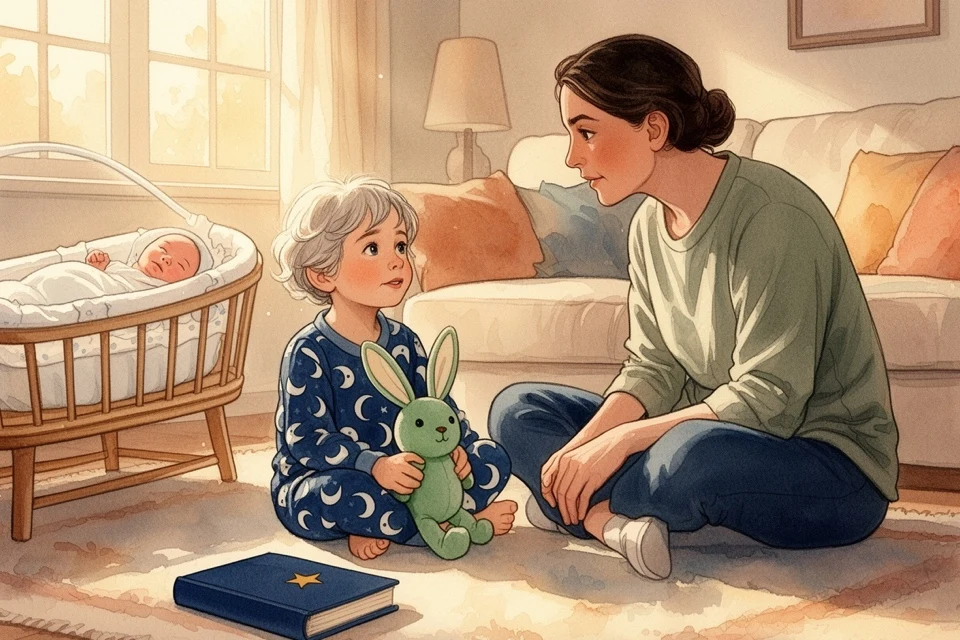
To make a personalized big sibling book, keep the older child at the center of the story. Show one change the new baby will bring, give the child a small and realistic part to play, and repeat what will stay the same: who cares for them, where they belong, and the routines they can count on. Add details only your family would know, then review every page before you print it. The book should open a conversation, not promise that nobody will ever feel jealous or left out.
A new baby can be hard to picture. Adults know what "you're going to be a big sister" means. A three-year-old may hear that sentence and imagine a ready-made playmate arriving next Tuesday. A good storybook makes the change more concrete without pretending it will all be easy.
What the book needs to do
The American Academy of Pediatrics, UNICEF, and NHS family guidance all recommend talking about the baby in age-appropriate terms, reading stories about new siblings, and involving the older child without forcing them into a role. That gives your book a useful job: it can rehearse a few likely moments and give the child words for questions or mixed feelings.
It cannot guarantee a smooth adjustment. It should not tell a child that they must love helping, that the baby will never disrupt anything, or that being "grown up" means they cannot ask for comfort. The least convincing page is often the cheeriest one.
| Helpful | Better left out |
|---|---|
| The baby may cry and need a lot of care | "The baby will always make you happy" |
| A parent may be busy for a while, then return | "Big kids never need help" |
| The child can choose whether to help | A permanent job as the baby's little caregiver |
| The child's feelings can change from day to day | A moral about jealousy being naughty |
| One familiar ritual will continue | A promise that every routine will stay identical |
The aim is reassurance through honesty. "Dad will feed the baby while Nana reads your usual bedtime book" gives a child something they can imagine. "Nothing will change" does not.
Decide when the story happens
Choose one short period instead of trying to explain the next five years of sibling life.
A book read before the birth might follow the day a trusted adult comes to stay, the parent goes to the hospital, and the child meets the baby. A book made after the baby arrives could cover a noisy afternoon when the child wants attention and the family finds a way to reconnect. For an older child, the plot might begin when they want to teach the baby a game and discover that a newborn is not ready yet.
Pick the point of view too. The older child should usually be the main character because the book is meant to help them find their place in the changing family. The baby can matter without taking over every page.
If the baby has not arrived, do not invent an exact personality. You can write about a baby who sleeps, wakes, cries, feeds, and watches faces. Leave room for the real person to surprise everyone later.
Gather the details that make it theirs
Names and hair color are only the surface. Spend ten minutes writing down details that anchor the story in your child's real life:
- What does the child call the baby, the parents, and other caregivers?
- Which toy, blanket, pet, or song helps them settle?
- What part of the daily routine are they most protective of?
- Who will care for them during the birth or homecoming?
- What are they excited about, and what have they already questioned?
- Which small task could they choose to try, such as selecting a onesie or singing a song?
- What are they too young to do safely on their own?
- Which detail should stay private and out of the book?
Use the family's actual words. If the child calls the baby "Bean" and their blanket "Blue Rabbit," those details will do more than a paragraph about how special they are.
Before adding family details to an AI prompt, decide which names, addresses, schools, medical information, photos, or other personal details should stay out. The UK Information Commissioner's Office recommends discussing privacy choices with children and agreeing what is acceptable to share.
Do not make the child responsible for the baby's feelings. "Mara chose the moon pajamas" is a real contribution. "Only Mara could stop the baby crying" turns reassurance into pressure.
Adjust the story to the child's age
Ages 1 to 2: show what can be seen
Keep the plot short and concrete. Show the cot, the small clothes, the sound of crying, and an adult holding the baby. Repeat the child's name and one reliable routine. At this age, "After the baby drinks milk, Mum sits with Leo for their song" is easier to grasp than an explanation about sharing attention.
Ages 2 to 4: tell the truth about the awkward bits
Preschoolers may be excited and still dislike waiting. Let the story include both. The baby can be cute and loud. The child can help on one page and say "not now" on another. Show where the child will stay during the birth and what happens when the parent comes home.
The AAP notes that some young children return to earlier behavior after a baby arrives. Your story does not need a toilet-training subplot, but it should avoid shaming the hero for wanting to be held, using a baby voice, or asking for an old comfort again.
Ages 5 and up: give them facts, not baby talk
An older child can understand that newborns cannot play immediately and that feeding, sleep, and crying will affect the household. Give them a real question to ask and a choice about helping. They may care more about lost one-to-one time or changed plans than about earning a "best big sibling" badge.
UNICEF recommends explaining both the welcome parts and the difficult parts in language the child can understand. That balance will make the story feel more trustworthy.
Use a six-beat plot
You do not need a grand adventure. This structure is enough for an illustrated book:
- The ordinary world: Show the child in a familiar place, doing something they enjoy.
- The change: The family explains that a baby is coming or has arrived.
- The honest worry: The child wonders who will read bedtime stories, where the parent will be, or why the baby cries.
- A small choice: They choose a picture for the nursery, pack their own overnight bag, or sing near the baby.
- The connection: An adult notices the child's effort and makes time for a familiar ritual.
- The open ending: The family is still learning. The child belongs without having to perform a perfect reaction.
Here is a prompt you can adapt:
Write a warm picture-book story for a four-year-old named Lina, who is becoming a big sister to a baby called Sam. Lina loves building blanket forts and always sleeps with a green rabbit. She is excited but worries that Mum will be too busy for their Saturday pancakes. Tell the story from Lina's point of view. The baby should cry and need care, but do not make Lina responsible for fixing everything. Let her choose one helpful action. End with Mum and Lina making pancakes while the baby rests nearby. Use our family words "Mum" and "Papa." Avoid calling Lina a big girl when she asks to be held.
For more control over pacing and illustration notes, use the AI storybook prompt guide. If you plan to include recognizable family members, the photo selection guide explains how to choose clear references without uploading more than the story needs.
Make the book in Storique
Use Storique when you want an original illustrated story rather than a fixed book with a name swapped into the same pages. You can choose up to three real people, animals, or fictional characters, describe the family situation, and shape the plot around the details you gathered.
Reference photos let Storique illustrate the older child recognizably across the book. If the baby has not been born, keep the older child as the photo-based hero and describe the baby without pretending to know their exact appearance. If you create the book later, you can include approved baby photos too.
The first version is a draft you control. You can edit the story, change text, regenerate or vary illustrations, add pages, and reorder them before approving the hardcover. That matters for this topic. A page that accidentally makes the older child look frightened, leaves out an important caregiver, or shows unsafe contact with a newborn should not go to print.
The Storique creation guide shows the full editor and ordering flow. The pricing page explains the hardcover package, and the guide to making a personalized storybook with photos covers the wider planning process.
If you only need a two-page announcement, a homemade booklet may be quicker. Storique makes more sense when you want the child to recognize their world in a complete story, review every page, and keep a printed book after the transition is no longer new.
Read it as a conversation, not a script
Read the book before the baby arrives if you can, then return to it when the household changes. Pause when the child corrects a detail. Ask what they think will happen next. If they dislike a page, listen before explaining why you wrote it.
Keep the book beside ordinary favorites rather than presenting it as homework about being nice to the baby. A child who wants a dinosaur story tonight has not failed the transition.
After the birth, update your words when reality differs from the plan. The hospital stay may be longer, the chosen helper may be unavailable, or the child may want no part in holding the baby. NHS guidance specifically advises respecting that choice. The book works best when it begins a conversation the family is willing to keep changing.
Frequently asked questions
When should I give a personalized big sibling book?
Start when the change is concrete enough for the child to discuss, while leaving time to read the story more than once and change any detail that confuses them. If the baby is already home, make the story about the routines the child is seeing now rather than the arrival you planned.
Can I make the book before the baby is born?
Yes. Center the older child, use the baby's name only if it has been chosen and is ready to share, and keep the baby's appearance and personality open. You can make a later edition with reference photos if the family wants a more recognizable sibling story.
Should the older child always help in the story?
No. Offer one safe, optional action. The child might choose a song, bring a clean nappy, or simply sit nearby. They should not be responsible for holding, feeding, settling, or supervising the baby without an adult.
Will a sibling book prevent jealousy?
No book can promise that. Jealousy, excitement, pride, and regression can all appear during a family change. A useful book gives the child familiar language, realistic expectations, and a reason to ask questions. Ongoing attention from caregivers matters more than a perfect ending.
Sources
- Preparing Your Older Child for a New Baby, American Academy of Pediatrics
- How to Prepare Your Child for a New Sibling, UNICEF Parenting
- Introducing Your Children to Your New Baby, NHS Norfolk and Waveney Children and Young People's Health Services
- Switched on to Privacy Checklist, UK Information Commissioner's Office
A little story magic, delivered.
New free stories, thoughtful gift ideas, and occasional Storique news — one lovely email at a time.
- Free stories
- Gift ideas
- Storique news