
A good birthday book needs less material than a birthday party. Pick one year, one thing the birthday person genuinely cares about, and a small problem they can solve. The cake can stay in the photos.
How to Make a Personalized Birthday Storybook

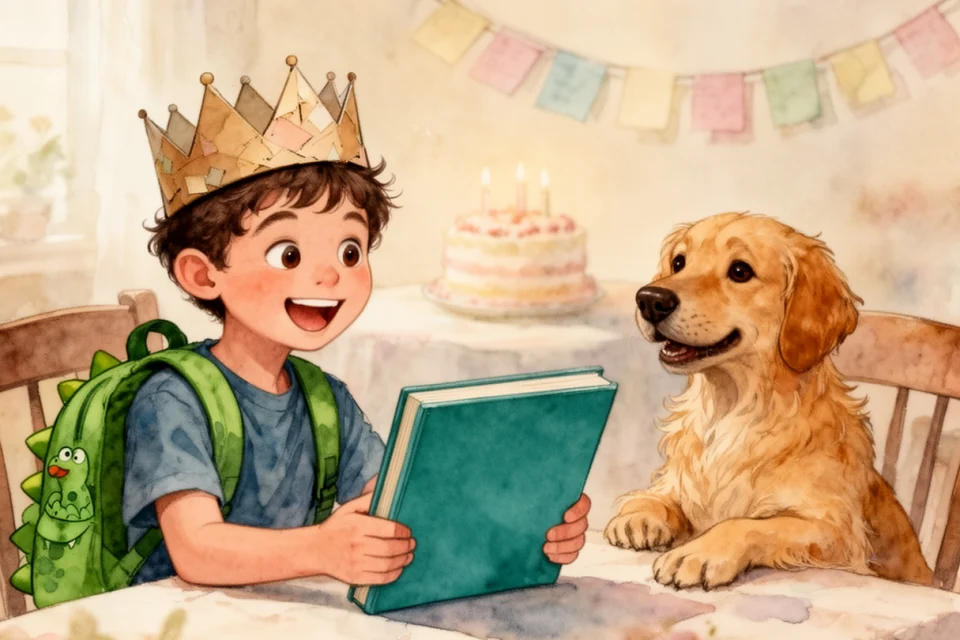
A good birthday book needs less material than a birthday party. Pick one year, one thing the birthday person genuinely cares about, and a small problem they can solve. The cake can stay in the photos.
Decide what the birthday book should remember
"Personalized birthday book" can mean several different projects. Choose the job before you collect pictures or write a prompt.
| If you want to keep... | Make... | Put at the center... |
|---|---|---|
| The party exactly as it happened | A photo book | Real pictures, names, dates, and short captions |
| Messages from family and friends | A tribute book | Letters, drawings, quotations, and signatures |
| A readable story about this person | A personalized storybook | A recognizable character, one plot, and details from their life |
Keep the original photos, cards, and voice notes outside the storybook.
Find the detail that makes the story theirs
Names and ages are labels. The personal part comes from details another family could not swap into its book.
Write down six things:
- an object the person uses or carries often;
- a place they would recognize immediately;
- a phrase or joke they actually say;
- a current interest, from dinosaurs to gardening;
- one person or animal who belongs in the story;
- a small choice the birthday hero can make.
If you are making the book with them, ask: "What should happen in your birthday adventure?" Keep the part of the answer with energy.
For a surprise, ask relatives for specific memories rather than adjectives. "When did she make everyone laugh this year?" will give you more than "What is she like?" The Library of Congress family oral-history guide recommends asking permission before recording and then asking relatives questions about their lives.
Do not assign feelings or dialogue you cannot verify. If Uncle Ben did not say, "This was the best day of my life," leave the sentence out.
Use photos for two different jobs
Party photos preserve what happened. Character photos show an illustrator what someone looks like. One picture can do both jobs, but it does not have to.
For a Storique character, choose 4 to 8 clear reference photos of that person alone. Include a front view and a few useful angles in steady light. The photo-selection checklist covers cropping, expressions, glasses, hair, and common rejection problems.
Keep a separate folder of memory references: the red bicycle, the party room, the dog beside the picnic table. Add a simple note to each file with who, what, where, and when. The U.S. National Archives recommends this basic metadata in its family digitization guide. It also advises retaining originals and backing up digital files.
Do not upload the entire camera roll. A smaller reference set is easier to inspect and exposes less personal information.
Give the birthday hero a real job
The weakest birthday plot is a parade of praise: everyone arrives, tells the hero they are wonderful, and produces a cake. Nothing the main character does changes the story.
Give them a problem suited to the reader. A child can find the missing candle, help a nervous dragon join the party, or choose a route through a familiar park. An adult can guide the family through a comic version of a shared memory. Keep the conflict light if the book is a gift, but let the hero notice, decide, or repair something.
This seven-scene plan is enough for a first draft:
- Familiar opening: Show the hero in a recognizable place with a real object or habit.
- Birthday wish: Give them one clear hope for the day.
- Small disruption: Something needed for that wish goes missing or goes wrong.
- First attempt: The obvious solution fails for a specific reason.
- Useful choice: The hero uses knowledge, kindness, patience, or humor that fits them.
- Return: Bring back the opening object or phrase with a changed meaning.
- Birthday ending: Close with the dedication, celebration, or quiet moment the giver wants remembered.
The Children's Museum of Manhattan uses family photos, drawings, and conversation in its family storybook activity. A handmade version is valid. Use Storique when you want an editable illustrated story that you can print.
Write a brief that leaves less to chance
Tell the story maker what must stay true, what it may invent, and what it must avoid. A long biography is less useful than a controlled brief.
Write a warm, funny birthday story for six-year-old Luca. He has curly brown hair, wears round blue glasses, and takes his green dinosaur backpack everywhere. His dog Miso may appear as the second main character. On the morning of Luca's birthday, the paper crown for his dinosaur party disappears. Luca notices tiny green scraps leading through the apartment and works out that Miso carried the crown to the balcony. End with Luca repairing the crown with a gold star and wearing it while the family brings out the cake. Keep the problem gentle. Do not add a villain, school name, address, magical powers, or dialogue from relatives. Use short sentences that are comfortable to read aloud.
The AI storybook prompt template has separate fields for characters, setting, plot, tone, exclusions, and illustration notes.
Match the book to the person, not the number
Toddlers need a visible action and a repeated phrase. Preschoolers can follow a problem with two or three attempts. Older children may enjoy choosing the genre or catching a joke that adults miss.
The American Academy of Pediatrics notes in its guide to sharing books with two- and three-year-olds that children this age often enjoy repeated phrases, familiar books, and talking about the pictures. Read the draft aloud. If the child cannot join the repeated line by the third time, simplify it.
For a teenager or adult, do not write down to them. A dry family comedy or a lightly fictionalized mishap may suit them better than a sugary celebration.
Build and edit the birthday book in Storique
Choose Storique when the gift needs an original plot and recognizable illustrated characters rather than a fixed story with a name inserted into it.
You can choose up to three real people, animals, or fictional characters. A real person uses 4 to 8 reference photos. After Storique creates the first version, you can edit the text and individual pictures, add or reorder pages, and review the whole digital book before deciding whether to order a hardcover. The finished book can also be read on the web or iPhone/iPad and downloaded as PDF or ePUB.
The editing stage matters. A generated picture may change the glasses, put seven candles on a sixth-birthday cake, or turn the green backpack blue. Treat the first version as a draft.
The Storique creation guide shows the order and editing flow. Pricing lists the current digital-book and optional hardcover costs.
Review it like a gift, not a demo
Use three passes. First, read only the story. Check that the hero makes the important choice and that the ending earns the celebration. Then inspect only the pictures: face, hair, glasses, hands, ages, recurring objects, candle count, and any text-like marks. Last, read the pages in order at normal size and check the title, dedication, page turns, and final line.
Ask someone who knows the recipient to review a surprise book. Give them a precise job: find wrong facts, not prettier alternatives. If a page gets the likeness wrong, change the prompt or regenerate that illustration. If the plot is generic, fix the outline and the words.
Keep the surprise without giving away private details
A birthday book rarely needs a full birth date, surname, school, home address, medical history, or daily schedule. First names and an age may be enough.
The UK Information Commissioner's Office defines data minimisation as collecting only the personal information required for a specific part of a service. Apply the same test to the plot and reference files: does this detail improve the book, or is it merely available?
Ask a parent or guardian before using photos of another child. Tell adult relatives if their image or words will appear. Keep the working files private, and do not post finished pages publicly just because the physical book is a gift.
Start before you need the wrapped book
Set your own deadline for the story and pictures, then leave time for another reader and at least one correction pass. Check the current print and delivery estimate before promising a hardcover for a particular date.
If the birthday is too close, finish the digital edition properly instead of rushing an unchecked print order. Read it on the day and order the hardcover after the recipient has checked the story.
For a first birthday built from a whole year of memories, use the baby memory book guide. For other birthdays, keep the scope smaller: one person, one plot, one year they can recognize.
Frequently asked questions
What should a personalized birthday book include?
Include the person's current age, a recognizable interest or habit, one familiar place, a small problem they can affect, and a closing dedication. Leave unrelated biography and private details out.
How many photos do I need for a birthday storybook?
Storique uses 4 to 8 clear reference photos for each real person. Memory photos of the party, objects, or places can remain outside the character set as planning references.
Can I make a birthday storybook as a surprise?
Yes. Ask one trusted relative to verify names, ages, relationships, and memories. Avoid invented quotations, and leave any uncertain detail out until the recipient can review it.
Is a birthday storybook only for young children?
No. Match the tone and plot to the recipient. Children may enjoy a simple adventure; a teenager or adult may prefer family comedy, travel, or a lightly fictionalized shared memory.
Can I edit a Storique birthday book before printing?
Yes. You can edit the text and pictures, add or reorder pages, and review the digital version before ordering an optional hardcover. Check likeness, facts, anatomy, recurring objects, and candle counts page by page.
Sources
- Family History for Kids: Oral Histories, Library of Congress
- Digitizing Family Papers and Photographs, U.S. National Archives
- Family Storybook, Children's Museum of Manhattan
- How to Share Books with Children 2 and 3 Years Old, American Academy of Pediatrics
- Children's code: data minimisation, UK Information Commissioner's Office

A little story magic, delivered.
New free stories, thoughtful gift ideas, and occasional Storique news — one lovely email at a time.
- Free stories
- Gift ideas
- Storique news