
To make a personalized pet storybook from photos, start with one behavior that feels unmistakably like your animal, build a short plot around it, and choose reference photos that clearly show the pet's face, body shape, coat markings, ears, paws, and tail. Then generate an illustrated draft, check that the same pet remains recognizable on every page, and revise the text and pictures before printing.
A good book is not made personal by adding a pet's name to a generic adventure. It becomes personal when the impatient nose at the cupboard, the white sock on one paw, or the suspicious relationship with the vacuum changes what happens next.
How to Make a Personalized Pet Storybook From Photos

To make a personalized pet storybook from photos, start with one behavior that feels unmistakably like your animal, build a short plot around it, and choose reference photos that clearly show the pet's face, body shape, coat markings, ears, paws, and tail. Then generate an illustrated draft, check that the same pet remains recognizable on every page, and revise the text and pictures before printing.
A good book is not made personal by adding a pet's name to a generic adventure. It becomes personal when the impatient nose at the cupboard, the white sock on one paw, or the suspicious relationship with the vacuum changes what happens next.
Choose the kind of pet story you want
Decide what the finished book is for before you sort the photos. A funny birthday gift needs a different ending from a quiet memorial book.
| Your goal | A useful story shape | Details worth gathering |
|---|---|---|
| Celebrate a living pet | One ordinary habit becomes a small adventure | Favorite toy, walking route, sleeping place, family nickname |
| Make a gift for a child | The pet helps solve a clear, gentle problem | The child's relationship with the pet, shared routine, reassuring ending |
| Remember a pet who died | One true memory is retold with care | Places, gestures, sounds, dates, and phrases the family remembers |
| Welcome a newly adopted pet | The animal explores the home and begins to belong | First day, safe places, early misunderstandings, new routine |
| Tell a two-pet story | Their different personalities move the plot | Who leads, who hesitates, what they do together |
Keep the promise small enough for a picture book. "Miso steals the gardening glove and accidentally leads everyone to a lost key" is easier to visualize than "the complete life of Miso." One afternoon, one problem, and one emotional turn are plenty.
If the book is a memorial, decide where fact ends and imagination begins. You can write a magical story based on a real animal without pretending every scene happened. A short note such as "inspired by Pepper's habit of waiting beside the garden gate" keeps the memory honest.
List the details the illustrations must keep
Before writing the plot, make a one-page character sheet. Do not rely on "small black dog" or "orange cat." Many animals fit those descriptions.
Record the features that would let a family member recognize this particular pet:
- Species, breed or mix, approximate size, and body shape
- Coat color, pattern, and texture
- Face shape, muzzle length, and eye color
- Ear shape and whether the ears sit differently
- Distinctive patches, socks, scars, whiskers, or tail shape
- Collar, tag, harness, or another familiar accessory
- A usual posture or expression
- Features that must not appear
Be literal. "Black dog with a white chest bib, left ear upright, right ear folded, slim legs, curled tail, and faded red collar" gives an illustrator more useful information than "our adorable little rescue dog."
Separate appearance from personality. A crooked ear belongs in every relevant illustration. A dislike of rain belongs in the plot. Keeping those notes apart makes both easier to check.
Pick photos that show shape and markings
Choose clear reference images, not merely favorite photographs. The picture that carries the strongest memory may show the pet as a blur at the far end of a beach. Keep it for inspiration, but do not make it the only visual reference.
A practical set includes:
- One face-on image with both eyes visible
- One left or right three-quarter view
- One full-body side view
- One image from the opposite side if the markings differ
- One close view of a feature the book must preserve
Soft daylight is helpful. Avoid strong filters, deep shadows, flash glare in the eyes, costumes that hide the body, and screenshots with a tiny subject. For a dark-coated pet, expose the photo so the face and outline do not disappear into the background.
The RSPCA's pet photography guidance suggests watching where an animal sleeps, what it plays with, and how it asks for things. It also recommends photographing natural behavior rather than forcing an action. That advice serves the story as well as the camera: the familiar behavior you notice may become the best plot idea.
Keep sessions short. Blue Cross advises letting the animal approach the camera, using short bursts, and stopping if the pet is unhappy, frightened, bored, or uncomfortable. You do not need a stressful photo shoot to make a convincing book.
If your only good images are old prints, digitize copies carefully and keep the originals. The US National Archives notes that digital files carry their own preservation risks and recommends retaining original photographs after digitization.
For a wider reference-image checklist, see how to choose photos for an AI storybook.
Build the plot from one real behavior
The easiest way to avoid a generic pet story is to begin with a repeated behavior. What does the pet do that makes everyone say, "Of course they did"?
Perhaps the dog carries one sock from room to room. The cat inspects every parcel. The rabbit moves a wooden toy into the water bowl. The old terrier refuses to walk past one blue gate. Any of those can create cause and effect.
Use a simple five-beat plan:
- Normal: Show the pet in a familiar place, doing its usual thing.
- Disruption: Something changes: a parcel arrives, a toy vanishes, or a visitor leaves a gate open.
- Attempt: The pet follows its habit and makes the problem funnier or more complicated.
- Discovery: That same habit reveals a clue or helps someone understand what happened.
- Return: The pet settles back into its routine, now with a small change the reader can feel.
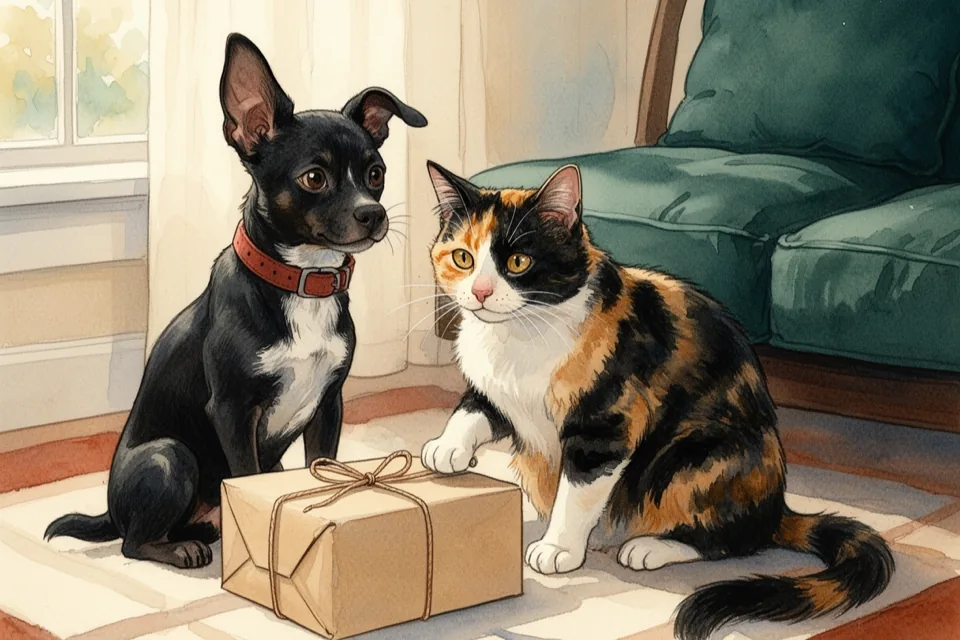
For example, a cat who checks every delivery could discover that a plain parcel makes a mysterious sound. The dog wants to tear it open; the cat insists on an inspection. Their disagreement leads them through the house until they learn that the "sound" is a lost toy rolling beneath the box. The ending returns them to the green window cushion, each convinced they solved the case.
That plot works because the animal behavior drives it. You could not swap in any random cat and dog without changing the story.
Write a prompt that protects the specifics
An AI prompt should tell the system what must remain stable and where it can invent. Include the reader, tone, character details, setting, problem, ending, and anything to avoid.
Try this structure:
Write a warm, funny picture-book story for a six-year-old about Juniper, a small black rescue dog with a white chest bib, one upright ear, one folded ear, and a faded red collar. Juniper carries one gardening glove whenever someone opens the back door. When the family's spare key disappears before a rainy walk, the glove habit should lead to the solution. Set the story in the real kitchen and small garden. Keep Juniper acting like a dog: no human clothes, speech, or impossible tricks. End with the family finding the key and Juniper settling on the green cushion with the glove. Use short read-aloud sentences and do not introduce a villain.
If the pet is deceased, say what emotional register you want. "Tender and specific, not sentimental; focus on a remembered morning walk and end with the family keeping the red lead by the door" gives better direction than "make it sad and beautiful."
Do not include an address, phone number, microchip number, school uniform, or other detail that the story does not need. If children appear in the photos or book, review what information is being shared and who can see it. The UK Information Commissioner's Office explains that privacy settings help control what personal information is collected, shared, or visible. Make those choices before uploading, not after the book is finished.
The AI storybook prompt guide has a longer template for character, problem, attempts, resolution, tone, and illustration notes.
Make the book in Storique
Storique is a good fit when the pet needs to be a recognizable character in an original story, not a name placed into fixed pages. You can choose up to three real people, animals, or fictional characters, supply reference photos, and describe the plot you actually want.
The first generated book is a draft you control. You can edit the text, regenerate or vary illustrations, add pages, and reorder them before approving the hardcover. That control matters with animals. A model may lose a chest patch, straighten a folded ear, change a collar, invent a second tail, or place the pet in an unsafe pose. You should be able to fix the page rather than accept the error because the rest of the book looks good.
Use the character sheet while reviewing. Check the face, markings, size, and accessories across several scenes rather than judging the cover alone. Then read the story aloud. A recognizable pet in a plot that drags is still an unfinished book.
The step-by-step Storique guide shows the creation and editing flow. Pricing explains the hardcover option, and the guide to making a personalized storybook with photos covers the wider planning process.
If you want a quick record of real images with dates and captions, make a photo book. Choose Storique when you want those visual references turned into a new, illustrated narrative that you can revise page by page and give as a printed story.
Check every page before printing
Review in three passes. On the first pass, look only at the animal. On the second, read only the words. On the third, check how the page turns work.
For the visual pass, compare each illustration with the character sheet and source photos. Count legs and tails. Inspect paws, eyes, collar hardware, coat boundaries, and reflections. Look for text-like marks on parcels, signs, tags, and book covers. Regenerate an image if the anatomy is wrong or the pet has drifted into a different animal.
For the story pass, remove repeated lessons and generic praise. Replace "the bravest dog in the whole world" with something the dog actually does. Check that a child can understand why one event causes the next. If the book is a memorial, ask someone else who knew the pet to flag invented details that feel false.
For the print pass, keep important faces and words away from the trim and center fold. Read the complete preview at normal size. Confirm the title, dedication, names, page order, and delivery details before approval.
Frequently asked questions
How many pet photos do I need for a personalized storybook?
There is no universal number. A small set of sharp photos that shows the face, both sides, full body, and distinctive markings is more useful than many repetitive or blurry images. Choose coverage and clarity first.
Can I make a storybook about a pet who has died?
Yes. Start with one memory or routine rather than trying to summarize the pet's entire life. Keep original photos separately, decide which scenes are factual or imagined, and use language that fits the family rather than forcing a cheerful ending.
Can a dog and cat appear in the same personalized book?
Yes. Give each pet its own description and reference set, then make their different behaviors part of the plot. Check every page for correct size, markings, and species-specific anatomy.
Is a pet storybook the same as a photo book?
No. A photo book arranges the real photographs themselves. A personalized storybook uses photos as visual references for illustrated characters inside a new narrative. If preserving the exact image is the priority, choose a photo book; if the pet should lead an editable adventure, choose a storybook.
Can I edit the Storique book before ordering it?
Yes. Storique lets you edit text, regenerate or vary illustrations, add pages, and reorder them before you approve the hardcover. Use that review stage to correct visual drift, awkward anatomy, or any plot detail that does not sound like your pet.
Sources
- Tips for Photographing a Pet, RSPCA Young Photographer Awards
- Six Tips for Photographing Your Pet, Blue Cross
- Digitizing Family Papers and Photographs, US National Archives
- Choosing settings, UK Information Commissioner's Office
A little story magic, delivered.
New free stories, thoughtful gift ideas, and occasional Storique news — one lovely email at a time.
- Free stories
- Gift ideas
- Storique news