
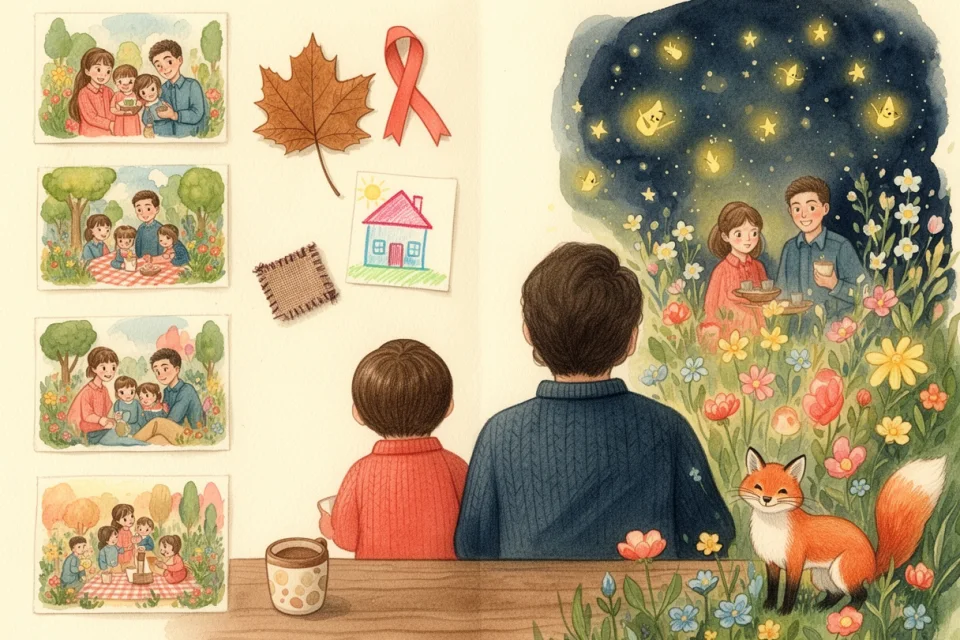
Choose a photo book when the photographs should stay at the center. Choose a memory book when handwriting, drawings, and small keepsakes matter as much as the pictures. Choose a personalized storybook when you want to turn one real memory or family idea into a story people can read aloud.
None of the three is the universal "best" family keepsake. They preserve different things: what the camera saw, what the family collected, or how a moment felt when you tell it as a story.
Photo Book vs Storybook: Which Family Keepsake Fits?

Choose a photo book when the photographs should stay at the center. Choose a memory book when handwriting, drawings, and small keepsakes matter as much as the pictures. Choose a personalized storybook when you want to turn one real memory or family idea into a story people can read aloud.
None of the three is the universal "best" family keepsake. They preserve different things: what the camera saw, what the family collected, or how a moment felt when you tell it as a story.
Photo book vs storybook vs memory book
| Format | What carries the book | Best for | Main work | Common disappointment |
|---|---|---|---|---|
| Photo book | Real photographs, usually with short captions | A trip, wedding, first year, or annual family record | Selecting, ordering, and laying out photos | Too many similar pictures and too little context |
| Memory book or scrapbook | Photos, handwriting, drawings, tickets, letters, and other flat keepsakes | A child's participation, school years, or a collection built over time | Gathering materials and assembling pages | An unfinished book that becomes too elaborate to continue |
| Personalized storybook | A beginning, problem, change, and ending, supported by illustrations | A read-aloud gift or one memory retold as an adventure | Shaping the story and reviewing text and pictures | A generic plot that uses names but misses the real person |
The boundaries are not perfectly tidy. A photo book can have long captions. A memory book can follow a timeline. Some photo-book tools now arrange images into a story and draft captions; Mixbook's current Story Mode is one example. The useful distinction is not whether the book contains text. It is which material you would be most upset to lose: the original photos, the physical traces and personal handwriting, or the narrative.
Choose a photo book when the pictures are the record
A photo book is usually the clearest choice when the images already tell most of the story. Think of a wedding, a family trip, a baby's first year, or one photograph from every month. The reader wants to see the real faces, rooms, clothes, and weather, not an illustrated version of them.
The hard part is selection. Camera rolls reward accumulation; books reward decisions. Pick the event or period first, then remove duplicates. A slightly imperfect photograph may deserve a page because it catches the right look or includes someone important. Five polished portraits cannot replace the only picture of a grandparent teaching a child to knead dough.
Captions should supply what the image cannot: names, places, dates, a line someone said, or the reason everybody is laughing. "Summer 2026" says less than "Pedro stole the picnic roll while we were taking this picture at Lake Balaton."
A printed photo book is a viewing copy, not a complete preservation plan. Keep the original digital files and backups. If you scan old photographs or letters, store the originals safely rather than trimming or gluing them into a new project. The US National Archives recommends preservation-quality storage and warns against pressure-sensitive "magnetic" albums, unknown plastics, rubber cement, and other materials that can stain or damage photographs.
Choose a memory book when hands and voices belong on the page
A memory book makes room for evidence that does not fit neatly into a photo layout: a child's drawing, a handwritten recipe, a pressed ticket, a school certificate, or three sentences dictated by someone who cannot write yet. The page can be uneven. That is part of its appeal.
This format also lets the recipient help make the keepsake. PBS Kids suggests asking a child to choose important events, draw favorite memories, add captions, title the book, and look through the finished pages together. That process matters when you want to hear which moments the child chooses, not simply present a polished gift.
Keep the project small enough to finish. One school term, one summer, or "things Grandma taught me" is easier to complete than a book promising to hold an entire childhood. Do not build a system that requires every receipt and drawing to earn a place.
Use copies when an original is fragile or irreplaceable. The Library of Congress advises against sticky self-adhesive pages for family photographs. Photo-safe corners or sleeves let you remove items later without peeling them from glue. A scan or good copy can live in the memory book while the original stays protected.
Choose a personalized storybook when the memory needs a plot
A personalized storybook does something different. It does not try to archive every fact from a birthday, holiday, or ordinary Tuesday. It takes one thread and gives it a shape.
Perhaps a child and her grandfather really did plant tomatoes together. In a photo book, you would show the seed trays, muddy hands, and first red tomato. In a memory book, you might add the seed packet and Grandad's handwritten instructions. In a storybook, the missing garden labels could become a small mystery that the two solve together. The details stay recognizable, but the pages have a goal, a change, and an ending.
That makes the format well suited to reading aloud. It can also include scenes nobody photographed: the joke told in the car, the moment before the surprise, or an imagined adventure built around a child's current obsession. The tradeoff is accuracy. An illustration is an interpretation, so do not use it as a replacement for the original family archive.
Names alone are not enough. Give the story a real phrase, object, habit, place, or choice. "Mila is brave and loves magic" could belong to thousands of books. "Mila calls the whisk a thunder spoon when she bakes with Dad" gives the writer and illustrator something that belongs to her.
If you use an AI storybook service, review every page. Check that the child acts rather than simply watches, the illustrations agree with the text, recurring people look consistent, and private details have not slipped into a scene or caption. The first generated version is a draft.
Five questions that make the choice easier
1. What must remain exact?
If the real photograph is the point, choose a photo book. If the original handwriting or paper object matters, choose a memory book and use safe mounting materials. If emotional truth matters more than a literal record, a storybook gives you more room to reshape the moment.
2. How will people use the book?
A coffee-table book favors photographs. A project a child can draw in favors a memory book. A bedtime book needs a story that works without somebody explaining every page.
Picture the actual reading moment. Who opens it, where do they sit, and what do you hope happens next? The answer is more useful than asking which format looks most impressive online.
3. How much source material do you have?
A strong photo set supports a photo book. A box of letters, drawings, recipes, and mementos points toward a memory book. One vivid anecdote can be enough for a storybook, especially if you also have clear reference photos for the people who appear in it.
Do not force the material into the wrong shape. Ten weak screenshots do not become a good photo book because you add a premium cover.
4. Who should do the making?
If you want a child or relative to add their own marks, leave physical space for them. If several family members need to send pictures, a digital photo-book workflow may be easier. If one person will shape and review a narrative as a surprise gift, a personalized storybook may fit better.
5. What will you realistically finish?
Choose the project that fits the time and attention you have. A finished 20-page book beats an ambitious heirloom that remains a folder called "someday." Set a boundary before you start: one event, one year, one relationship, or one story.
For a gift, compare the full delivered price and work backward from the date. Leave time to select materials, edit the book, correct mistakes, and ship it. A fast creation tool cannot rescue a project that reaches the printer after the birthday.
The personalized storybook cost guide breaks that total into the book format, creative work, revisions, extra copies, tax, and shipping.
You can combine the formats without making a muddle
A hybrid works when each part has a job. You might preserve the originals separately, print a small photo book as the factual record, and turn one favorite incident into an illustrated storybook.
Within one book, keep the hierarchy clear. Use real photographs for a short "what really happened" section at the end of an illustrated story, or add a pocket of copied photos to a handwritten memory book. Readers should be able to tell what is original, remembered, or invented.
Before using anyone's image, letter, or private anecdote, ask. A surprise does not need to expose a school name, home address, medical detail, or story the person would rather keep private.
If a personalized storybook is the right fit
Start with one person, one small memory, and one change. Then gather clear reference pictures and write down the details that must survive the retelling. The guides to making a personalized storybook with photos, choosing useful reference photos, and writing an AI storybook prompt cover the practical work.
Storique's step-by-step guide shows how to turn that story idea and your selected photos into an illustrated draft that you review before ordering a printed book. If the photo book or handmade memory book won your comparison, make that instead. Storique is useful here only if you want the illustrated story.
Frequently asked questions
Is a personalized storybook the same as a photo book?
No. A photo book normally prints the photographs themselves as the main visual record. A personalized storybook uses a narrative and illustrations, which may be created from reference photos, to place recognizable people inside a story.
Is a photo book or storybook better for a young child?
Choose based on the reading moment. A photo book can help a child revisit real people and events. A storybook is better when you want a beginning, a problem, and an ending to read aloud. A sturdy handmade memory book works when the child should draw, dictate captions, or add pages.
What should I do with original photographs and letters?
Keep irreplaceable originals in suitable storage and use scans or copies in projects that involve glue, handling, or display. Avoid sticky "magnetic" album pages and unknown plastics. For damaged or historically important material, consult a qualified conservator rather than attempting a repair at home.
Sources
- How to Preserve Family Archives, US National Archives
- Care, Handling and Storage of Photographs, Library of Congress
- Make a Memory Book, PBS Kids for Parents
- How Mixbook Story Mode works, Mixbook
A little story magic, delivered.
New free stories, thoughtful gift ideas, and occasional Storique news — one lovely email at a time.
- Free stories
- Gift ideas
- Storique news