
To make a family recipe storybook, choose one dish and the person whose way of making it you want to remember. Record them cooking, write down the usable recipe separately, and build the story around a small moment in the kitchen: a missing ingredient, a lesson, a mistake, or a family ritual. Keep the tested recipe with the finished book so readers can enjoy the story without treating invented details as cooking instructions.
A recipe answers "how much?" and "how long?" A story answers the questions families usually ask later: Who made this first? Why did they never measure the cinnamon? Who was allowed to lick the spoon? You need both records, but they do not have to do the same job.
How to Make a Family Recipe Storybook

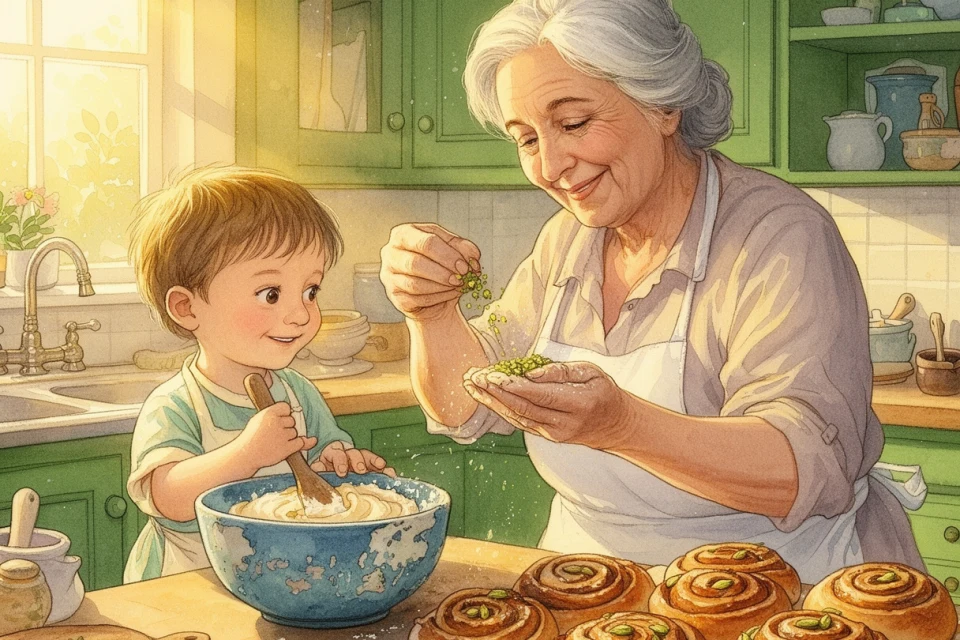
To make a family recipe storybook, choose one dish and the person whose way of making it you want to remember. Record them cooking, write down the usable recipe separately, and build the story around a small moment in the kitchen: a missing ingredient, a lesson, a mistake, or a family ritual. Keep the tested recipe with the finished book so readers can enjoy the story without treating invented details as cooking instructions.
A recipe answers "how much?" and "how long?" A story answers the questions families usually ask later: Who made this first? Why did they never measure the cinnamon? Who was allowed to lick the spoon? You need both records, but they do not have to do the same job.
Decide whether you need a cookbook or a storybook
Start with the way the book will be used. If someone needs to cook several family dishes from it, make a cookbook. If a child should meet the person behind one special dish, make a storybook. You can create both from the same interview.
| What you want to preserve | Best format | What it should contain |
|---|---|---|
| Exact ingredients and method | Recipe card or cookbook | Tested quantities, equipment, timings, temperatures, yield, and substitutions |
| Original handwriting and marks | Scan or memory book | Clear images of both sides, captions, names, and dates |
| The cook's voice and memories | Audio or written interview | Their phrases, corrections, pauses, and stories |
| One memorable kitchen episode | Family recipe storybook | Characters, a small problem, action, sensory details, and an ending |
Do not force a whole family cookbook into a picture-book plot. One dish is enough. The Library of Congress guide to collecting family recipes recommends adding family anecdotes and comments. These are also the raw material for a story.
Record the cook before you tidy the recipe
Ask the person to make the dish while you watch. A seated interview can capture history, but cooking reveals instructions that have become automatic: the pan they always choose, what "enough flour" looks like, or the sound that means the onions are ready.
Record video or audio with permission, then take notes. Ask short questions while there is something concrete to point at:
- Who taught you this recipe?
- When did your family usually make it?
- Which step do people rush or get wrong?
- What do you look, smell, or listen for instead of using a timer?
- Which kitchen mistake became part of the family story?
- Who should learn to make it next?
Let the cook finish before chasing the next question. The Library of Congress article on preserving family stories explains oral history as interviewing people who experienced events directly and offers sample questions for relatives.
Keep uncertain details uncertain. "We think Aunt Klara began making this after the family moved to Vienna" is better than inventing a neat date. The family-story preservation guide has a fuller interview and backup workflow.
Make a recipe that another person can follow
Before writing the story, prepare a separate practical recipe. List ingredients in the order used, plus the pan size, oven setting, yield, visual cues, rest time, and any step the cook normally keeps in their head.
Test it with someone who missed the interview. Ask them to mark every guess. "Bake until done" may be clear to Grandma and useless to everyone else.
Treat food safety as fact, not family style. Older recipes may omit temperatures or use outdated methods. FoodSafety.gov's safe minimum internal temperature chart covers meat, poultry, seafood, eggs, casseroles, and leftovers. Check authoritative local guidance too, especially for canning, preserving, or raw eggs. Do not ask a story generator to repair an unsafe recipe.
Preserve the original wording beside the tested version. That lets you keep "a teacup of flour" as part of the family record while giving today's cook a measured quantity they can use.
Find the story hiding inside the dish
A recipe story needs an event, not a tour through the ingredient list. Look back at the interview and choose one moment when somebody wanted something, tried something, and changed the situation.
Useful story shapes include:
- A child wants to make the birthday cake before the guest of honor arrives, but the handwritten card leaves out one step.
- A grandparent teaches two cousins to fold dumplings, and each develops a different, recognizable method.
- A sauce tastes wrong until the cook remembers the tiny step their father never wrote down.
Keep the real recipe intact outside the plot. In the story, flour can puff across the table and the wooden spoon can disappear at the worst moment. In the practical recipe, quantities and safety instructions should remain boringly precise.
Write one sentence that keeps the plot honest:
This is a story about eight-year-old Leo learning why Great-Aunt Marta crushes the cardamom by hand while they make the buns she baked after moving to Sweden.
If a scene does not help that story, leave it out.
Build a short page plan
Six story beats are enough for a first draft:
- Arrival: The child enters a specific kitchen on the day the dish is made.
- Promise: The cook explains what they are making and who it is for.
- Problem: A tool, ingredient, or unwritten instruction causes trouble.
- Work: The characters try, notice, taste, ask, and correct.
- Meaning: The cook shares the memory attached to the dish.
- Table: The food is served and the child takes one part of the tradition forward.
Use details the family can verify: the chipped blue bowl, the apron's deep pocket, or the rule that the first bun is always shared. Avoid turning a relative into a flawless wise elder. People are easier to recognize when they tease, forget, and have opinions about the correct spoon.
The ending should show transmission rather than announce a moral. Leo labels his own cardamom jar, or a cousin writes the missing step on a copy of the recipe.
Write a prompt that separates fact from invention
Give the storybook maker the verified people, place, action, and ending. State what it may invent and what it must not change.
Write a warm picture-book story for an eight-year-old about Leo baking cardamom buns with Great-Aunt Marta in her small green kitchen. Marta wears a red apron with a deep pocket and crushes cardamom by hand. Leo wants to learn the buns for his mother's birthday. The old recipe card omits when to add the butter, so Leo must watch, ask, and write the missing step on a fresh card. Marta tells him she first baked the buns after moving to Sweden. End with the family sharing them at the birthday table and Leo labeling his own cardamom jar. Keep the move as a family memory rather than adding historical claims. Do not change ingredient quantities, invent allergies, or present the story as a tested recipe.
The AI storybook prompt guide has a reusable structure for characters, plot, tone, exclusions, and illustration notes. If you want recognizable family members in the art, follow the photo-selection checklist before uploading references.
Make the illustrated version in Storique
Storique is a strong fit when the goal is an original illustrated story about the cook and child, not a database of recipes or a fixed template with names inserted. You can choose up to three real people, animals, or fictional characters, add reference photos, and describe the kitchen memory you want the plot to preserve.
The generated book remains editable. You can change the text, regenerate or vary individual illustrations, add pages, and reorder them before deciding whether to order a hardcover. Review matters here: an image may alter a family object, put raw and cooked food together, or turn handwriting into nonsense.
Check the draft in three passes:
- Compare every factual sentence with the interview.
- Compare recurring people, utensils, clothing, and rooms across the illustrations.
- Remove any image or line that could be mistaken for an unverified cooking instruction.
Keep the scanned card and tested recipe outside Storique as the family record. The story adds a way to read the memory together; it should not replace the source material. The Storique creation guide explains the digital book, editing tools, downloads, and optional hardcover, while pricing lists current costs.
Protect the originals and the people in the book
Scan fragile recipe cards instead of taking them into a working kitchen. Keep food and drink away from old photographs. The guide to digitizing old family photos covers handling, file names, master files, and backups.
Ask before recording someone, publishing their words, or using their photograph. If a child appears, include only details the story needs. The UK Information Commissioner's Office explains data minimisation as collecting and retaining only what a specific purpose needs. A nickname and red apron may improve the book. A surname, school, address, and full birth date probably will not.
Give the family a chance to correct the draft, especially when the story crosses generations or countries. Translation can preserve a family phrase alongside a short explanation rather than replacing it with a tidier equivalent.
Frequently asked questions
What is a family recipe storybook?
A family recipe storybook is an illustrated narrative about the people and memory behind a dish. It may sit beside a tested recipe, scanned card, or cookbook, but its main job is to tell what happened and why the food matters.
How many recipes should go in one storybook?
Start with one. A picture book needs room for characters, a problem, and an ending. If you want to preserve many usable recipes, make a separate cookbook and turn the strongest memory into its own story.
Can I use an old handwritten recipe?
Yes, but scan both sides and preserve the original. Transcribe the words exactly, record uncertainty, and test the recipe separately. Do not assume an old cooking temperature or preserving method is safe today.
What if the family recipe has no measurements?
Record the cook making it, weigh or measure ingredients as they work, and note visual, sound, and texture cues. Test the written version with another cook. Keep phrases such as "until it feels right" in the interview record, but add enough detail for the practical recipe to be repeatable.
Is Storique a cookbook maker?
Storique is designed for illustrated stories, not recipe storage or kitchen-reference layouts. Use it to turn one recipe memory into a narrative starring recognizable family members. Keep tested quantities and food-safety instructions in a separate recipe card or cookbook.
Sources
- How to collect family recipes, Library of Congress
- Preserving family stories, Library of Congress
- Safe minimum internal temperatures, FoodSafety.gov
- Children's code: data minimisation, UK Information Commissioner's Office

A little story magic, delivered.
New free stories, thoughtful gift ideas, and occasional Storique news — one lovely email at a time.
- Free stories
- Gift ideas
- Storique news